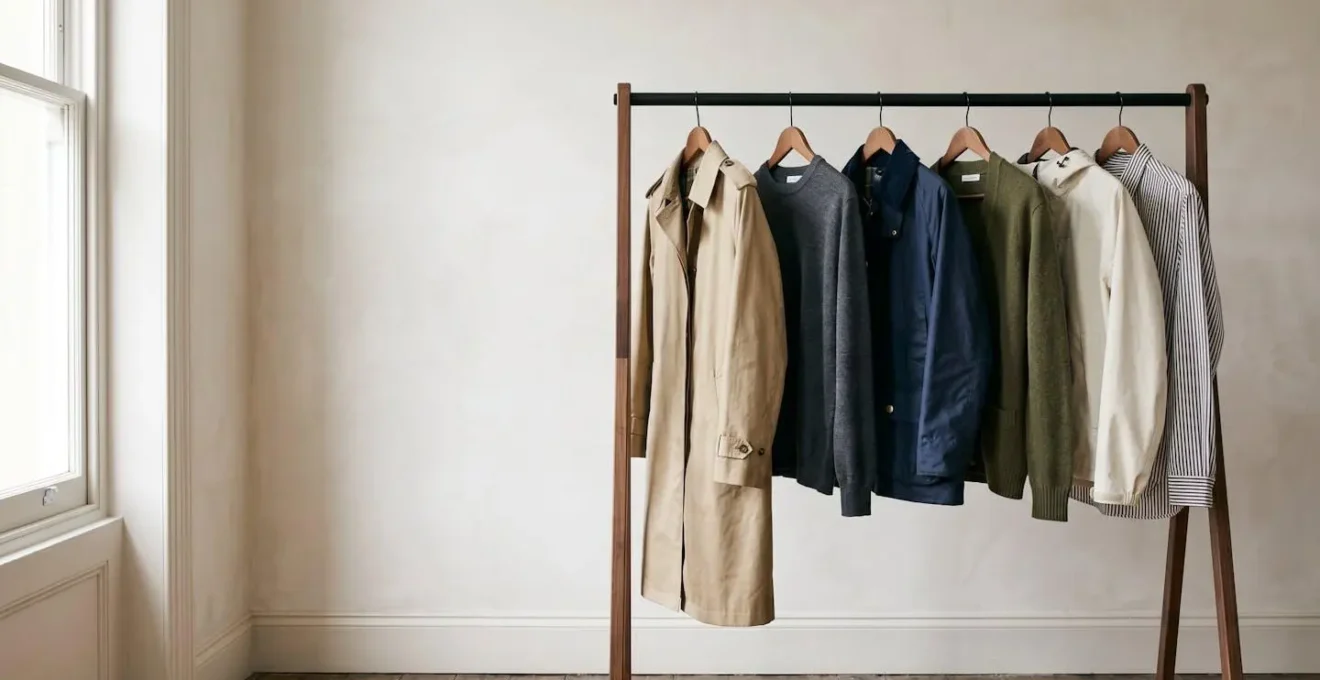
The secret to a functional UK wardrobe isn’t owning less; it’s owning the right technical gear to conquer the weather, which in turn saves you money, time, and stress.
- True value is measured by ‘Cost-Per-Wear’, not the initial price tag. A £200 waterproof coat worn daily is cheaper than a £50 ‘fashion’ coat that fails and needs replacing.
- The wrong fabrics (like cotton base layers) actively work against you in damp climates, making you feel cold and clammy. Fabric science is non-negotiable.
Recommendation: Instead of a generic declutter, start with a ‘Wardrobe Weather Audit’. If a piece of clothing doesn’t solve a specific British weather problem, it’s not earning its place.
There’s a specific kind of misery that every UK resident knows intimately. It’s the damp chill that seeps through a “shower-resistant” coat in a sudden downpour. It’s the sweat-then-freeze cycle on the morning commute, caused by a stylish-but-unbreathable jacket. It’s the quiet frustration of a wardrobe full of clothes, yet having nothing truly suitable to wear for the actual weather outside. For too long, the solution has been framed as a matter of minimalist aesthetics or chasing fleeting trends, leading to a cycle of buying, disappointment, and replacement.
Many guides suggest building a capsule wardrobe with a generic list: a white t-shirt, a pair of jeans, a trench coat. While well-intentioned, this advice often fails to address the fundamental, non-negotiable reality of life in Britain: the weather. A cheap trench coat won’t survive a sideways Mancunian rain shower, and a standard cotton tee is a poor choice for a damp day on the Cornish coast. We’re told to declutter, but we’re not told what to keep, or more importantly, *why*.
But what if the key wasn’t about simply owning fewer things, but about building a strategic, 30-piece *system*? What if your wardrobe wasn’t a collection of clothes, but a set of tools engineered to keep you comfortable, dry, and confident, no matter what the forecast says? This is the anti-consumerist secret: a truly sustainable wardrobe is a functional one. It’s about performance, not just appearance. It starts not with looks, but with the science of fabric and the economics of longevity.
This guide will walk you through building that system. We’ll dismantle the financial fallacy of fast fashion, decode the fabrics that are heroes and villains in a damp climate, and provide a practical, month-by-month plan to transition to a slow fashion mindset without feeling deprived. It’s time to stop dressing for the life we see on Instagram and start dressing for the life we actually live.
Summary: How to build a wardrobe that survives British weather
- Why a £200 Trench Coat Is Cheaper Than Replacing Cheap ones Annually?
- How to Store Winter Woolens to Prevent Moth Damage in Summer?
- Statement Piece or Basic Staple: Which Should You Buy First?
- The Fabric Mistake That Makes You Sweat and Freeze Simultaneously
- How to Transition to Slow Fashion over 12 Months Without Bankruptcy?
- Why Buying Cheap Rain Gear Will Ruin Your Hike in 30 Minutes?
- How to Declutter a 50sqm Apartment in One Weekend Without Stress?
- Why Embracing Slow Living Saves Londoners Over £200 a Month?
Why a £200 Trench Coat Is Cheaper Than Replacing Cheap ones Annually?
The concept of a £200 coat feeling “cheaper” than a £50 one seems counterintuitive, but it’s the foundational principle of a functional wardrobe. The illusion of saving money on fast fashion disintegrates when you shift your metric from the initial price tag to Cost-Per-Wear (CPW). This simple calculation—dividing the item’s price by the number of times you wear it—reveals the true financial drain of disposable clothing. It’s the difference between an investment and a recurring expense.
Consider the data. A fast-fashion jacket at £50 might feel like a bargain. But its poor construction and non-weatherproof materials mean it looks worn after just ten wears, and fails completely in the first real downpour. Its CPW is a steep £5 per wear, before you’re forced to replace it. In contrast, a £200 trench coat made from properly waterproof and breathable fabric, designed to last for years, becomes a sound investment. If you wear it 100 times in its first year alone (a conservative estimate for a UK resident), its CPW plummets to £2. After 200 wears, it’s £1.
Cost-per-wear analysis: Quality vs fast fashion comparison
A formal cost-per-wear analysis reveals the true value of investment pieces. If you buy a jacket for $200 and wear it 50 times, the cost per wear is $4. By contrast, a $50 dress worn only twice has a cost per wear of $25. This calculation demonstrates that higher-priced sustainable pieces often offer better value than their fast fashion counterparts, which typically last only 5-10 wears before showing significant wear. The high-quality item not only performs better but is financially more sensible over its lifespan.
This isn’t about luxury; it’s about logic. Investing in one high-quality, functional piece eliminates the need to buy and replace multiple inadequate, cheaper versions. Over three years, you might spend £150 replacing the failing £50 coat annually, while the single £200 coat is still performing perfectly. The “expensive” option has actually saved you money and provided superior performance throughout. Building a slow fashion wardrobe is a series of these strategic financial decisions.
How to Store Winter Woolens to Prevent Moth Damage in Summer?
A truly sustainable wardrobe is one that lasts, and for your precious woolens, the battle is won or lost during the off-season. In the UK, the dual threat is not just the notorious clothes moth, but also the pervasive damp that can lead to mildew and musty smells, even in summer. Storing your knitwear correctly is a non-negotiable part of the slow fashion cycle, ensuring your investment pieces are pristine and ready for the first autumn chill. Simply tossing them into a vacuum bag is a common mistake that can damage natural fibres.
The key is a pre-storage ritual that addresses both pests and moisture. Every single wool item must be thoroughly cleaned before being put away. Moths are attracted to microscopic food particles and body oils, not the wool itself. A gentle wool wash or a professional dry clean removes this lure. This is also the perfect time to de-pill and make any small mends, ensuring your sweaters emerge from storage in better condition than when they went in. This act of care is central to the slow living ethos.
Once clean, storage itself requires a specific approach. Avoid airtight plastic bins; they trap any residual moisture, creating a perfect environment for mildew in a typical British home. Instead, opt for breathable containers like canvas bags or traditional cedar chests. Natural repellents are your allies here. Forget harsh chemical mothballs; sachets of lavender, rosemary, cloves, and cedar blocks are effective deterrents. For a traditional (and free) British method, scattering dried conkers amongst your clothes is an age-old trick. A mid-summer check-up, airing items on a rare sunny day, provides the final layer of protection.
Your 5-Step Wool Care and Storage Audit
- Pre-storage ritual: Deep clean and de-pill all wool garments, addressing the dual British threat of moths and damp before packing away.
- Choose breathable storage: Avoid airtight plastic containers which trap moisture; opt for canvas bags or traditional wooden chests to prevent mildew.
- Employ natural protection: Use pheromone moth traps for monitoring, and natural repellents like lavender, rosemary, and the traditional British method of conkers.
- Mid-summer check-up: Inspect stored items halfway through summer, airing wool in direct sunlight on a sunny day to naturally deter pests and damp.
- Autumn awakening: Steam and reshape sweaters upon retrieval to remove creases and restore their loft, preparing them for the new season.
Statement Piece or Basic Staple: Which Should You Buy First?
In traditional fashion parlance, a “statement piece” is a visually loud item—a brightly coloured coat or a uniquely shaped bag. A “staple” is a neutral basic. When building a functional, weather-proofed wardrobe, these definitions are not just unhelpful; they’re fundamentally wrong. You must redefine these terms based on performance and utility, not aesthetics. In a UK capsule, the first and most important purchases are your staples, and these staples *are* your statement pieces.
Think of your wardrobe as a toolkit. You wouldn’t buy a decorative, seldom-used tool before you have a high-quality hammer and screwdriver. The same logic applies here. Before you even consider a “fun” jacket, you must acquire your foundational, high-performance staples. These are the pieces that solve the most pressing physical discomforts you’ve experienced in the past month—were you cold, were you wet, were your feet soaked? The answers dictate your first purchases: properly waterproof boots, a genuinely warm and weatherproof coat, merino wool base layers.
A true “statement” in a UK context is a piece that makes a statement of competence and preparedness. It’s a ‘Performance Hero’—an item of exceptional technical capability that also happens to look good. This could be a sleek, fully waterproof parka from a brand like Rains or a highly technical jacket from Finisterre that looks just as good in the city as it does on a coastal path. You earn the right to buy these ‘Performance Heroes’ only after your core comfort needs are met by a foundation of versatile, weather-resistant essentials. The goal is to build a wardrobe where the average versatility of each item is high. A staple should work in at least five different combinations; a statement piece can be justified if it works in two or three, but it comes later.
This table outlines the practical framework for making purchasing decisions. The priority is always function first.
| Criteria | Basic Staple | Statement Piece |
|---|---|---|
| Minimum Styling Combinations | 5+ different ways with existing 30 items | 2-3 styling combinations required |
| Purchase Priority | First – foundation building phase | After core wardrobe has high average multiplier |
| Weather Functionality Test | Must address physical discomfort (wet, cold) from past month | Can be purchased only after comfort needs met |
| Definition for Practical Wardrobe | Weather-resistant essentials (waterproof boots, quality coat) | ‘Performance Hero’ with exceptional technical capabilities that looks good |
| UK Context Example | Fully waterproof parka, merino base layers, waxed cotton jacket | Stylish technical piece from brands like Finisterre or Rains |
The Fabric Mistake That Makes You Sweat and Freeze Simultaneously
It’s a sensation every commuter or walker in the UK has felt: you rush for the train, layered up against the rain, and arrive on the platform feeling hot and clammy. Then, as you stand still, a deep, unpleasant chill sets in. This “sweat and freeze” cycle isn’t a personal failing; it’s a fabric failing. It is the direct result of the most common and critical mistake in dressing for a damp, temperate climate: wearing a moisture-absorbing base layer underneath a non-breathable “waterproof” shell.
This miserable experience is a lesson in physics. Your body produces moisture (sweat) when you exert yourself. If your base layer is made of cotton—the number one fabric villain—it acts like a sponge, absorbing that moisture and holding it against your skin. It loses all its insulating properties when wet. Meanwhile, if your outer layer is a cheap, PU-coated “raincoat,” it might stop rain getting in, but it also stops moisture from getting out. You are effectively sealed inside a plastic bag, steaming in your own sweat. When you stop moving, the trapped moisture rapidly cools, stealing your body heat and causing that dangerous chill.
The solution is the ‘holy trinity of layering’: a system where each layer has a specific job.
- The Wick Layer (Base): This layer’s only job is to pull moisture away from your skin. The undisputed hero here is Merino wool. It wicks moisture effectively and, crucially, stays warm even when damp.
- The Warmth Layer (Mid): This layer provides insulation. It can be a fleece, a down vest, or a thicker wool sweater. Its effectiveness depends on the base layer keeping you dry.
- The Weather Layer (Shell): This layer protects you from wind and rain. It MUST be both waterproof and breathable (e.g., Gore-Tex, Ventile, or high-quality waxed cotton) to allow the moisture wicked by your base layer to escape.
The person in the image below is comfortable precisely because their clothing system is allowing moisture to escape while blocking rain from entering, preventing the sweat-and-freeze cycle.
Choosing the right fabric isn’t an optional extra; it is the entire basis of comfort and functionality in a UK wardrobe. The table below categorises the heroes and villains.
| Fabric | Category | Performance in UK Damp Climate | Best Use |
|---|---|---|---|
| Merino Wool | HERO | Natural moisture-wicking, retains warmth when damp, antibacterial properties | Base layer (wick layer) for all conditions |
| Waxed Cotton | HERO | Water-resistant, breathable, develops character over time, re-waxable | Weather layer for traditional British style |
| Ventile | HERO | Tightly woven cotton that swells when wet to block water, highly breathable | Weather layer for extended outdoor exposure |
| Gore-Tex | HERO | Waterproof (28,000mm HH), windproof, breathable membrane technology | Weather layer for severe conditions |
| Cotton (base layer) | VILLAIN | Absorbs moisture, stays wet, loses all insulation when damp, causes chilling | Avoid as base layer in British weather |
| Acrylic Knits | VILLAIN | No warmth retention when damp, non-breathable, pills easily | Avoid for outdoor British wear |
| PU-coated ‘Raincoats’ | VILLAIN | Waterproof but zero breathability, causes internal condensation and clammy feeling | Avoid for active wear or commuting |
How to Transition to Slow Fashion over 12 Months Without Bankruptcy?
The idea of switching to a slow fashion wardrobe can feel daunting. Investment pieces have higher price tags, and the thought of a complete overhaul is financially intimidating. The key is to reject the idea of an overnight transformation. This is not a sprint; it’s a gradual, deliberate process over 12 months. The goal is to strategically replace failing fast-fashion items with durable, functional pieces, using a disciplined and financially manageable approach. This shift in purchasing habits is already underway, with 25% of youngest Gen Zs buying fewer fashion items overall.
The transition starts not with buying, but with a pause. For the first two months, impose a no-buy period. This isn’t punishment; it’s an observation phase. Catalogue what you have. More importantly, catalogue what you *actually wear* and in which situations you feel your clothing is failing you. During this time, sell at least five unworn items on platforms like Vinted or Depop. The money you make forms your dedicated ‘Slow Fashion Fund’. This isn’t new money; it’s capital unlocked from your existing, under-utilised assets.
Your first purchase, using this fund, should be a second-hand staple. A high-quality trench coat, leather boots, or a Barbour jacket can often be found in excellent condition on second-hand markets for a fraction of their retail price. The following months are about maintenance and mindset. Implement a ‘Mend and Maintain’ month, investing in shoe repairs or jacket re-waxing. Enforce a ‘Second-Hand First’ rule for any new item, forcing you to explore charity shops and online platforms before even considering buying new. This methodical approach breaks the cycle of impulsive buying and builds a wardrobe based on need, not novelty.
Here is a practical roadmap for your year-long transition:
- Months 1-2: The No-Buy Audit. Catalogue your wardrobe and create a ‘Slow Fashion Fund’ by selling 5 unworn items on Vinted, Depop or eBay.
- Month 3: The Second-Hand Staple. Use your fund to buy one key second-hand piece, like quality boots or a heritage coat.
- Month 4: Mend and Maintain. Invest in professional repair services to extend the life of items you already own.
- Months 5-7: The ‘Second-Hand First’ Pledge. For any desired item, commit to searching the second-hand market for at least three weeks before buying new.
- Months 8-10: Track Your Wins. Create a simple cost-per-wear spreadsheet to visualise the value you’re getting from your new purchases versus old habits.
- Months 11-12: Review and Plan. Assess your transformed wardrobe. Identify the true gaps and plan your one or two strategic purchases for the year ahead.
Why Buying Cheap Rain Gear Will Ruin Your Hike in 30 Minutes?
Anyone who has hiked in the UK knows that the weather can turn in an instant. A sunny morning in the Peak District can become a windswept, rain-lashed afternoon without warning. In these moments, your rain gear is not an accessory; it is your most critical piece of safety equipment. The promise of a ‘waterproof’ jacket for £30 is a dangerous illusion. It will not just make you uncomfortable; it has the potential to ruin your hike and even put you at risk within the first 30 minutes of a downpour.
The term “waterproof” is not a simple yes/no attribute; it’s a measurable scientific standard known as the Hydrostatic Head (HH) rating. This measures, in millimeters, how much water pressure a fabric can withstand before it starts to leak. According to UK waterproofing standards and outdoor gear testing, a fabric needs a minimum HH rating of 1,500mm just to be legally classified as waterproof. However, this is only sufficient for a brief dash through light drizzle. For serious hiking in the rain, where you have the pressure of backpack straps and the friction of movement, a rating of 15,000mm is considered the practical minimum.
Cheap rain gear typically has a rating below 5,000mm. While it might fend off a light shower for a few minutes, under the sustained pressure of a backpack strap or the driving force of wind-blown rain, it will “wet out” almost immediately. The fabric becomes saturated, loses all breathability (if it had any to begin with), and the cold, heavy material clings to you, accelerating heat loss. Your glorious day on the fells turns into a miserable, sodden retreat. Investing in a jacket with a 20,000mm+ HH rating is not an indulgence; it’s a rational decision to ensure your comfort and safety in the unpredictable British outdoors.
The table below decodes these ratings and puts them into the context of real-world UK hiking scenarios.
| Waterproof Rating | UK Scenario | Duration / Conditions | Typical Failure Points |
|---|---|---|---|
| <5,000mm | ‘Shower-resistant’ jacket | 10-minute dash in light drizzle only | Immediate saturation under backpack straps; wets out in minutes under pressure |
| 5,000mm | Urban commute / dog walking | Light rain, short exposure without backpack | Fails under mechanical pressure (sitting, kneeling, pack straps); no protection in sustained rain |
| 10,000mm | Day walk in Wales with expected rain | Several hours of moderate to heavy rain whilst walking | The practical threshold for UK hill walking; begins to fail with heavy packs over extended periods |
| 15,000mm | Multi-day hiking in changeable weather | Heavy rain combined with backpack pressure and movement friction | Suitable for most serious UK hiking; may show limits in extreme sustained downpours |
| 20,000mm+ | Scottish Highlands, winter conditions | When the forecast is ‘biblical’ – sustained downpours, strong wind, long exposure | Maximum protection for UK mountain environments; Gore-Tex standard (28,000mm HH minimum) |
How to Declutter a 50sqm Apartment in One Weekend Without Stress?
The image of a minimalist, perfectly curated wardrobe is alluring, but the process of getting there, especially in a compact 50sqm flat, can feel overwhelming. The traditional advice to “empty your entire wardrobe” often results in a mountain of clothes, decision fatigue, and a weekend lost to stress. It’s no wonder that in the average UK household, ⅓ of clothes have not been worn in the last year; we’re simply too overwhelmed to deal with them.
To succeed, you must reframe the goal. This isn’t a “decluttering” project; it’s a “Wardrobe Weather Audit.” Your mission is not to simply get rid of things, but to critically assess each item’s performance against the demands of British weather. This provides a clear, objective criterion that cuts through emotional attachment. Start on Saturday morning by emptying your wardrobe, but with a specific question for each item: ‘For which specific British weather scenario is this the perfect piece?’ If you can’t answer immediately and specifically (e.g., “This is for a wet, windy day in October when I’m walking to the station”), it goes into a ‘review’ pile.
Next, implement the ‘Reverse Packing’ method. Put everything from your ‘review’ pile into bags or boxes. For the next two weeks, live out of these bags, only taking out what you actually need to wear each day. This is a real-world test of your wardrobe’s utility. At the end of the two weeks, you’ll be left with a clear-eyed view of what you truly need versus what you thought you needed. Anything remaining in the bags after this period can be critically assessed for donation or sale with a newfound sense of detachment. Crucially, at the end of Day 1 of your audit, bag up all the definite ‘donate’ items and take them straight to a charity shop to prevent a change of heart. Keep only what is comfortable, functional, and makes you forget you’re even wearing it.
Key Takeaways
- Reframe value: Focus on Cost-Per-Wear, not the initial price tag, to make sound financial investments in your clothing.
- Master the science: A functional wardrobe is built on a 3-part layering system (wick, warmth, weather) using the right technical fabrics like Merino wool and Gore-Tex.
- Function over fashion: Your wardrobe is a system to solve the problem of British weather; every piece must earn its place by performing a specific function.
Why Embracing Slow Living Saves Londoners Over £200 a Month?
For the time-poor, cash-conscious Londoner, the concept of “slow living” can seem like an unaffordable luxury. Yet, when applied to your wardrobe, it becomes a powerful tool for financial savings and stress reduction. Moving from a reactive, fast-fashion habit to a curated, slow-fashion system directly translates into tangible monthly savings that can easily exceed £200, simply by eliminating the hidden costs of an inadequate wardrobe.
The savings come from multiple, often overlooked, areas. There’s the obvious saving from ending impulsive lunch-break shopping sprees, a habit that a functional capsule wardrobe renders obsolete. But the real financial wins are more subtle. How often has a “fashion” coat that isn’t waterproof led to a last-minute Uber ride in a downpour? That’s a direct cost of a non-functional wardrobe. What about the “pick-me-up” coffees bought after a stressful morning spent dressed inappropriately for the weather? Or the cost of replacing poor-quality shoes and clothes that wear out after one season? These are the financial leaks that a slow-fashion approach plugs.
Embracing a slow-living mindset means shifting from a ‘replace’ to a ‘repair’ mentality. It means having your favourite boots resoled by a cobbler instead of buying a new pair. It means re-waxing your jacket instead of discarding it. This not only saves money but also reclaims time and mental energy—no more hours wasted browsing online, no more hassle with returns, no more daily indecision on what to wear. The result is a calmer, more controlled, and financially healthier existence.
This table breaks down a conservative estimate of the monthly savings achieved by switching from a typical fast-fashion consumption pattern to a mindful, slow-living approach in a city like London.
| Expense Category | Fast Fashion Habit (Monthly) | Slow Living Approach (Monthly) | Monthly Savings |
|---|---|---|---|
| Impulsive lunch-break shopping | £60 (2-3 Zara/H&M purchases) | £0 (capsule wardrobe eliminates impulse buys) | £60 |
| Emergency transport costs | £40 (last-minute Ubers because ‘fashion’ coat isn’t waterproof) | £8 (occasional ride-share; proper weatherproof gear enables walking) | £32 |
| ‘Pick-me-up’ purchases | £25 (Pret coffees after stressful mornings dressed inappropriately for weather) | £10 (reduced stress from functional wardrobe) | £15 |
| Clothing replacements | £80 (replacing poor-quality items that wear out) | £20 (occasional investment piece or repair service) | £60 |
| Online shopping browsing | £50 (2 hours/month on ASOS + returns hassle) | £0 (content with curated wardrobe) | £50 |
| TOTAL MONTHLY | £255 | £38 | £217 |
| Time Reclaimed | – | 5+ hours per month (decision-making, shopping, returns) | Invaluable for time-poor Londoners |
Start today by taking the first small, concrete step. Don’t try to overhaul everything at once. Simply begin by conducting your own ‘Wardrobe Weather Audit’ on a single drawer, or commit to the ‘Second-Hand First’ pledge for your very next clothing purchase. This is how a lasting, functional, and truly chic wardrobe is built.