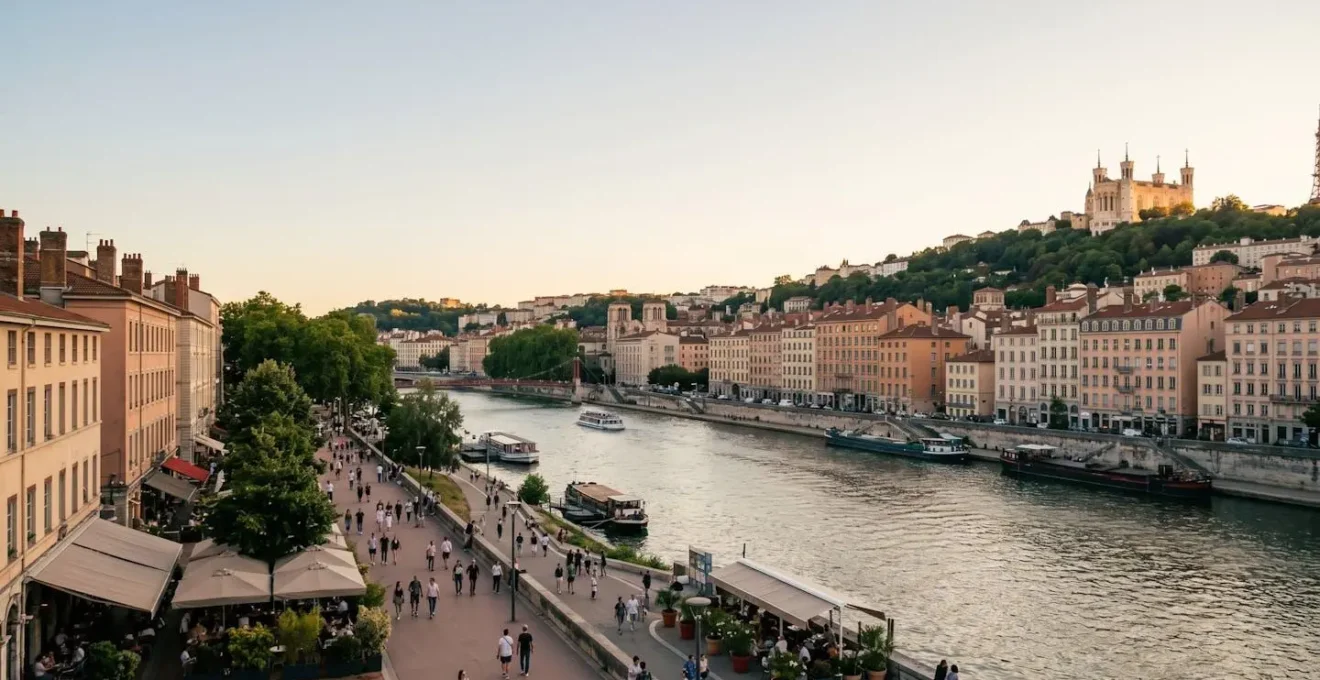
Choosing Lyon over Paris is not a compromise; it’s a strategic upgrade for a better, less stressful, and more affordable French experience.
- Your budget stretches significantly further, with daily costs that are dramatically lower than in the capital.
- You trade queueing and metro-hopping for genuine cultural immersion in a city built for walking and discovery.
Recommendation: Reframe your city break goal from “seeing landmarks” to “experiencing a culture” to maximize your travel satisfaction and return on investment.
The dream of a French city break for many couples begins and ends with Paris. It’s a vision of shared croissants under the Eiffel Tower, romantic walks along the Seine, and the unparalleled art of the Louvre. But the reality in recent years often involves navigating overwhelming crowds, facing eye-watering prices, and spending a significant portion of precious holiday time in a queue or a crowded metro car. This fatigue has led savvy travelers to ask a crucial question: is there a way to experience the essence of French urban life without the burnout?
The standard advice is often a simple “go elsewhere,” but this misses the point. The goal isn’t to abandon the dream of a vibrant French city experience, but to find a place where that dream can be fully realized. This is where Lyon, France’s second city, emerges not as a consolation prize, but as a strategic and superior alternative. It’s a choice that champions a more sustainable form of travel—one that’s kinder to your wallet, your time, and your sanity.
This isn’t about what Lyon lacks compared to Paris, but about what it offers in its own right. It’s about a fundamental shift in your travel return on investment (ROI), where every euro spent and every hour invested yields a richer, more authentic experience. We will explore how Lyon delivers a higher “experiential density,” allowing you to immerse yourself in culture rather than just observing it from a distance.
This guide breaks down the practical and philosophical reasons why your next French city break should be in Lyon. We’ll delve into tangible benefits, from budget and food to walkability and time efficiency, showing you how to build a trip that feels like a true escape, not a logistical challenge.
Summary: Why Lyon Is a Smarter Choice Than Paris for a City Escape
- How Much Further Does Your Budget Go in Lyon vs Paris?
- Why Second-Tier Cities Offer Better Food Experiences?
- Walkability Score: Why You Don’t Need the Metro in Lyon?
- The Monday Mistake That Ruins City Breaks in Provincial France
- How Many Days Do You Really Need to See Lyon?
- Staycation in Cornwall or Train to Provence: Which Is Truly Greener?
- Croatia or Cyprus: Where Can You Go When Your Schengen Days Run Out?
- How the 90/180 Day Rule Ruins Your Long European Summer?
How Much Further Does Your Budget Go in Lyon vs Paris?
The most immediate and tangible benefit of choosing Lyon is the profound relief you’ll feel in your wallet. It’s not just a little cheaper; it offers a fundamentally different value proposition. For a couple looking to enjoy a city break without constantly calculating costs, this difference is liberating. It transforms the trip from a series of spending decisions into a flow of enjoyable experiences. The financial barrier to entry for a high-quality experience—a nice meal, a comfortable hotel, a cultural activity—is simply much lower.
Hard data paints a clear picture. According to analysis of real traveler spending, the daily cost per person can be dramatically different. One report finds a typical day in the capital can be significantly more expensive than in Lyon, with data suggesting you might spend around €155 per day in Lyon versus €265 in Paris. This isn’t a minor saving; it’s a 42% reduction in daily expenditure. Over a three-day weekend for two, this adds up to hundreds of euros that can be reallocated to better-quality dining, an extra activity, or simply saved.
Let’s break down what this means for a typical 48-hour weekend. The cost of accommodation, often the biggest single expense, is substantially lower. A comfortable, well-located mid-range hotel in Lyon can cost a fraction of its Parisian equivalent. This pattern repeats across the board, from your morning coffee to your evening wine.
| Category | Lyon (€) | Paris (€) | Savings in Lyon |
|---|---|---|---|
| Hotel (2 nights, mid-range) | €180 | €300 | €120 |
| 4 Meals (2 casual, 2 nice) | €120 | €200 | €80 |
| 2 Cultural Activities | €30 | €50 | €20 |
| Local Transport | €20 | €35 | €15 |
| Total 48h Weekend | €350 | €585 | €235 (40% less) |
This table illustrates the core of Lyon’s “Travel ROI”: your money buys you a similar, if not better, quality of experience for substantially less. This financial breathing room is the foundation of a more relaxed and enjoyable city break, freeing you to focus on discovery rather than your bank balance.
Why Second-Tier Cities Offer Better Food Experiences?
Paris has world-class restaurants, but Lyon *is* a world-class restaurant. This is the crucial distinction. While the capital offers high-end dining often geared towards international tourists, Lyon’s culinary identity is deeply woven into the fabric of the city itself, accessible to everyone. This is a city where gastronomy is not a luxury, but a way of life. The experience is less about chasing reservations at celebrity-chef outposts and more about discovering incredible quality in a humble-looking “bouchon.”
This isn’t a new phenomenon. Lyon’s reputation was cemented nearly a century ago. As the famed 20th-century food critic Curnonsky declared in 1935, Lyon is the “world capital of gastronomy.” This title wasn’t just a marketing slogan; it was a recognition of a deep-rooted culture built on exceptional local produce and a tradition of hearty, authentic cooking. Today, that legacy lives on, not just in its fine dining establishments but in every market, bistro, and bakery.
Lyon is the world capital of gastronomy.
– Curnonsky (food critic Maurice Edmond Sailland), Official declaration made in 1935
The city’s excellence is quantifiable. While Paris has more Michelin-starred restaurants in absolute terms, Lyon boasts an incredible density of quality. With around 5,300 eateries and 17 Michelin-starred restaurants, the ratio of excellence is staggering. This means exceptional food is not only more affordable but also more readily available. You’re more likely to stumble upon a life-changing meal in a casual Lyonnais bistro than you are in many parts of Paris, where tourist traps are a constant threat.
This is the “second-city advantage” in action. The food scene is less influenced by global tourist demand and more by the discerning palates of locals. This fosters an environment of authenticity and quality, where a meal is an experience of culture, not just consumption.
The heart of this experience is the “bouchon,” a type of restaurant unique to Lyon that serves traditional, meat-heavy dishes in a convivial, unpretentious setting. Dining in a bouchon is an immersion in local culture. It’s about shared carafes of wine, robust flavors, and the lively hum of conversation—an experience that feels a world away from the formal, often impersonal, dining of a global capital.
Walkability Score: Why You Don’t Need the Metro in Lyon?
You don’t need the metro in Lyon because the city is a masterpiece of urban design, where the journey itself is the destination. Unlike the sprawling expanse of Paris that necessitates constant reliance on underground transport, Lyon’s most fascinating districts are compressed into a manageable, human-scale core. This transforms your city break from a series of disconnected “stops” into a seamless, flowing experience of discovery. You spend your time exploring, not commuting.
The city is effectively organized into three main areas for a visitor: the historic Vieux Lyon (Old Lyon), the elegant Presqu’île (the peninsula between the two rivers), and the bohemian slopes of Croix-Rousse. A motivated walker can traverse all three in a single day. This “experiential density” is Lyon’s secret weapon. You can start your morning in a Renaissance courtyard in Vieux Lyon, cross the Saône river for lunch on the Presqu’île, and end your afternoon exploring the creative workshops of Croix-Rousse, all on foot.
This walkability is enhanced by one of Lyon’s most unique features: the traboules. These semi-secret covered passageways, originally used by silk merchants to transport their goods, form a hidden network through the buildings of Vieux Lyon and Croix-Rousse. Exploring them is like unlocking a secret level of the city, a treasure hunt that reveals hidden courtyards and spiral staircases. This is an experience you simply cannot have in Paris. It’s an intimate, unforgettable way to connect with the city’s history. The following plan provides a template for your own discoveries.
Action Plan: The Insider’s Walkable Lyon
- Start at Place Bellecour, one of Europe’s largest public squares, to get your bearings and see the city’s scale between its two rivers, the Rhône and the Saône.
- Navigate through Vieux Lyon’s secret traboules. These covered passageways, once used by 19th-century silk merchants, are now open to the public for a unique urban exploration.
- Take the funicular up to Fourvière hill. This “walkability enhancer” effortlessly conquers the city’s main elevation, giving you breathtaking views without the exhausting climb.
- Walk down from the Basilica through the ancient Roman amphitheater site, experiencing millennia of history in a single, scenic descent.
- Complete your circuit back on the Presqu’île, having explored the city’s core almost entirely on foot in just a few hours—a feat impossible at the scale of Paris.
This is what it means to truly experience a city. Instead of the stress of navigating a complex transport system, your energy is spent absorbing the beauty, history, and atmosphere around you. It’s a slower, more deliberate, and ultimately more rewarding way to travel.
The Monday Mistake That Ruins City Breaks in Provincial France
One of the classic pitfalls for travelers in France outside of Paris is “le lundi.” A couple plans a long weekend, arriving on Friday and leaving on Monday, only to discover that on their final day, most museums, many shops, and some popular restaurants are closed. This can lead to a frustrating end to an otherwise wonderful trip. In many cities, Monday feels like a day of forced rest and missed opportunities. But in Lyon, this potential problem becomes another opportunity to experience the city’s unique charm.
Lyon gracefully sidesteps the “Monday mistake” because so much of its appeal lies beyond traditional ticketed attractions. The city’s lifeblood flows through its public spaces, its markets, and its vibrant neighborhoods, most of which are just as enjoyable—if not more so—on a quiet Monday. Instead of finding closed doors, you discover a more local, peaceful side of the city.
While some museums do close, many of Lyon’s best experiences are always open. A perfect Monday could involve a long, leisurely stroll through the magnificent Parc de la Tête d’Or, France’s largest urban park, which also houses a free botanical garden and zoo. You could spend hours exploring the vibrant street art on the slopes of the Croix-Rousse, an open-air gallery that never closes. The beautiful pedestrianized quays along the Rhône and Saône rivers are perfect for a walk or a bike ride, with many riverside cafes remaining open. Even the famous food market, Les Halles de Lyon Paul Bocuse, operates on Monday morning. And for a museum fix, the stunning Musée des Confluences is one of the few major museums in France that is open on Mondays.
Here is a practical itinerary for a perfect provincial Monday that other cities can’t offer:
- Morning: Explore the Parc de la Tête d’Or, a vast green oasis that’s always open and offers free access to its botanical garden and zoo.
- Midday: Stroll the pedestrian-friendly riverside quays along the Rhône and Saône, stopping at an outdoor terrace that remains open for a drink.
- Afternoon: Discover the vibrant street art on the Pentes de la Croix-Rousse, an outdoor gallery that requires no tickets or set opening hours.
- Late Afternoon: Visit the Musée des Confluences, a world-class science and anthropology museum that is uniquely open on Mondays, unlike most of its French counterparts.
- Evening: Indulge at the Halles de Lyon Paul Bocuse, a legendary gourmet food market where many vendors operate beyond typical Monday closure times.
In Lyon, Monday isn’t a dead end; it’s an invitation to see the city as the locals do, enjoying its ample green spaces and dynamic public life.
How Many Days Do You Really Need to See Lyon?
This question reveals the core difference between a Lyon and a Paris city break. In Paris, the answer is often “as many as possible, and it still won’t be enough.” The city’s sheer scale and the endless list of world-famous landmarks can induce a sense of “fear of missing out” (FOMO). A short trip can feel like a frantic dash, leaving you exhausted and with a feeling of having only scratched the surface. Lyon, however, is different. It’s a city you can truly *complete*.
For a rich, comprehensive experience of Lyon, three to four days is the sweet spot. This is enough time to explore the main districts at a leisurely pace, enjoy several long, wonderful meals, visit a museum or two, and even take a half-day trip to the Beaujolais wine region. Crucially, in three days in Lyon, you can leave feeling satisfied and that you’ve truly “done” the city, rather than feeling like you’ve just run out of time.
This is a direct result of the city’s superior “experiential density.” You spend less time in transit and more time actually having experiences. A case study analysis illustrates this point perfectly.
The 3-Day Lyon Deep Dive vs. The 3-Day Paris Surface Dash
Travel analysis shows that a 3-day trip to Lyon allows for a deep, immersive experience. Because of the city’s compact and walkable nature, travelers report spending up to 80% of their time on actual cultural immersion—walking historic districts, dining in authentic bouchons, and interacting with locals. In contrast, on a typical 3-day Paris trip, it is estimated that as much as 40% of a visitor’s time can be consumed by metro travel between distant arrondissements, queueing for major landmarks like the Eiffel Tower or the Louvre, and navigating dense crowds. This means a short break in Lyon delivers a complete, satisfying narrative, while a short break in Paris often feels like a series of disconnected, rushed moments.
The psychological benefit for a couple on a limited break is immense. You can relax and sink into the city’s rhythm, knowing you don’t have to rush. The goal is no longer to tick off a list but to savor the atmosphere. Before you go, auditing your potential itinerary for this “experience density” is a key part of planning a successful, stress-free trip.
Your 5-Point City Break ‘Experience Density’ Audit
- Map & Transit Ratio: List your ‘must-sees’ on a map. Calculate the estimated total transit time between them versus the time you’ll spend at the activities. Is the ratio favorable, or are you spending too much time moving?
- Queue Risk Assessment: Identify the major attractions on your list and research their average wait times for the season you’re visiting. Are there high-quality, no-queue alternatives you could substitute?
- Spontaneity Potential: Look at your planned routes. How easy would it be to deviate from the plan and discover something wonderful on foot? A high score here means the city is built for enjoyable, spontaneous exploration.
- Authenticity Access: Count the opportunities for non-tourist experiences (local markets, neighborhood cafes, parks where locals gather) within easy reach of your base. More access means easier immersion.
- Relaxation Factor Review: Read your itinerary aloud. Does it sound like a frantic checklist to be completed or a framework for genuine relaxation and discovery? Adjust until it feels like the latter.
Key Takeaways
- Lyon offers a superior travel ROI, with daily costs that can be over 40% lower than in Paris, allowing for a higher quality trip on the same budget.
- The city’s compact, walkable nature maximizes “experiential density,” replacing stressful transit time and long queues with immersive discovery.
- Choosing Lyon is a sustainable act against overtourism, rewarding you with a more authentic and intimate cultural experience that is difficult to find in a global capital.
Staycation in Cornwall or Train to Provence: Which Is Truly Greener?
The question of a “greener” or more sustainable holiday is often framed as a choice between staying local and traveling abroad. But there’s a third, more nuanced option: choosing your destination strategically to combat the negative effects of overtourism. In this light, opting for Lyon over Paris is one of the most powerful “green” choices a traveler can make. It’s a vote for a more balanced, sustainable tourism ecosystem that benefits both the visitor and the destination.
Paris is a victim of its own success. The sheer volume of visitors puts immense strain on the city’s infrastructure, heritage sites, and local quality of life. The problem is reaching a critical point, with tourism statistics showing Paris and its region expecting an immense number of visitors. One recent report estimated nearly 49 million visitors to Paris in 2024. This creates an environment where visitors often feel like part of a herd, shuffling from one crowded icon to the next.
Choosing a second city like Lyon is an active step to alleviate this pressure. You are redirecting your tourist spending and presence to a place that can absorb it more comfortably and where your visit is more likely to be appreciated. The result for you, the traveler, is a dramatically improved experience. You trade crowds for space, and tourist-centric artifice for local authenticity.
This isn’t just a theory; it’s a tangible feeling reported by countless travelers who have experienced both cities. It’s the difference between feeling like an observer and feeling like a participant in the city’s life. Travel blogger Latifah from the Gimme Confetti blog perfectly captures this sentiment.
Lyon is less crowded than Paris… I found Lyon to be significantly less crowded with tourists than Paris. This made it a nicer and more intimate experience making it more easier to immerse in the local culture.
– Travel blogger Latifah, Gimme Confetti travel blog
This “intimate experience” is the true reward of a sustainable choice. By choosing Lyon, you’re not just avoiding the crowds of Paris; you’re investing in a more pleasant and meaningful trip for yourself while contributing to a healthier model of tourism for France as a whole.
Croatia or Cyprus: Where Can You Go When Your Schengen Days Run Out?
This question, familiar to long-term travelers, is about one thing: maximizing a limited resource. When your Schengen days are dwindling, you seek out destinations that let you make the most of the time you have left. The same logic should be applied to a short city break. Your vacation days are a precious, finite resource. Choosing a destination that wastes them on logistical friction—like long airport transfers and tedious daily commutes—is a poor return on your investment.
This is where Lyon’s time-efficiency advantage becomes a game-changer. From the moment you land, Lyon is designed to get you into the heart of the experience faster. This starts at the airport. The Rhônexpress tram is a dedicated service that connects Lyon-Saint Exupéry Airport to the city center’s Part-Dieu station in under 30 minutes. It’s clean, efficient, and stress-free.
This contrasts sharply with the often-cited experience of arriving in Paris. Depending on traffic or public transport issues, the journey from Charles de Gaulle (CDG) or Orly airports to the city center can easily take an hour or more. This isn’t just an inconvenience; it’s a significant portion of your first day lost to transit. A comparative analysis highlights this stark difference, with Lyon’s 30-minute Rhônexpress connection being a clear winner against the potential 60-plus minutes from Paris CDG via the RER train.
This time-saving principle extends throughout your stay. As we’ve seen, Lyon’s walkability means your days are filled with activities, not with descending into the metro. Minutes saved on every journey add up to hours of extra discovery, relaxation, or time spent enjoying a leisurely meal. When you only have 48 or 72 hours, these saved hours are priceless. They represent an entire extra museum visit, a spontaneous exploration of a new neighborhood, or another glass of wine on a sun-drenched terrace. Choosing Lyon is like hacking your vacation to have more of the good stuff.
How the 90/180 Day Rule Ruins Your Long European Summer?
The Schengen 90/180 day rule is a perfect metaphor for the constraints of modern travel. It represents a hard limit on a precious resource: time. But travelers are also constrained by two other critical resources: money and energy. A successful city break is one that maximizes the value you get from all three. The ultimate reason to choose Lyon over Paris is that it offers a superior return on investment across this entire portfolio. It is, quite simply, the smarter use of your limited resources.
We’ve seen how your budget goes further in Lyon. This isn’t just about saving money, but about what that financial freedom allows. It allows for spontaneity, for saying “yes” to an unplanned experience, and for upgrading your comfort level without guilt. The difference is significant, with comprehensive data showing it is substantially cheaper to live—and therefore to visit—in Lyon. According to one analysis, the overall cost of living is 24% cheaper in Lyon than Paris, a figure that directly translates to your experience as a visitor.
We’ve also seen how Lyon saves you time and energy. Less time in transit, fewer crowds, and a more manageable scale mean you end your day energized by your discoveries, not exhausted by logistics. This is the essence of a real vacation. It should be restorative, not depleting. This feeling of manageability and civic pride is often the lasting impression visitors take away, a stark contrast to the often-overwhelming nature of the capital.
This sentiment is perfectly captured by travelers who have experienced both. It’s the feeling of being able to connect with a city on a human level. One family traveler on the “Have Twins Will Travel” blog summarized it beautifully.
We spent three nights in Lyon and we loved it, it’s like a Paris you can actually wrap your head around… There’s tons of civic pride in Lyon, we heard it everywhere and especially in relation to that other big city in France.
– A family traveler, Have Twins Will Travel
“A Paris you can actually wrap your head around.” This is the ultimate value proposition. Lyon delivers the quintessential French city experience—the beauty, the history, the food, the culture—but in a package that is accessible, affordable, and deeply rewarding. It respects your time, your budget, and your desire for an authentic connection.
To put these principles into practice, your next logical step is to start planning a city break where your time, money, and energy are truly valued. It’s time to discover what a smarter French escape feels like. It’s time to discover Lyon.