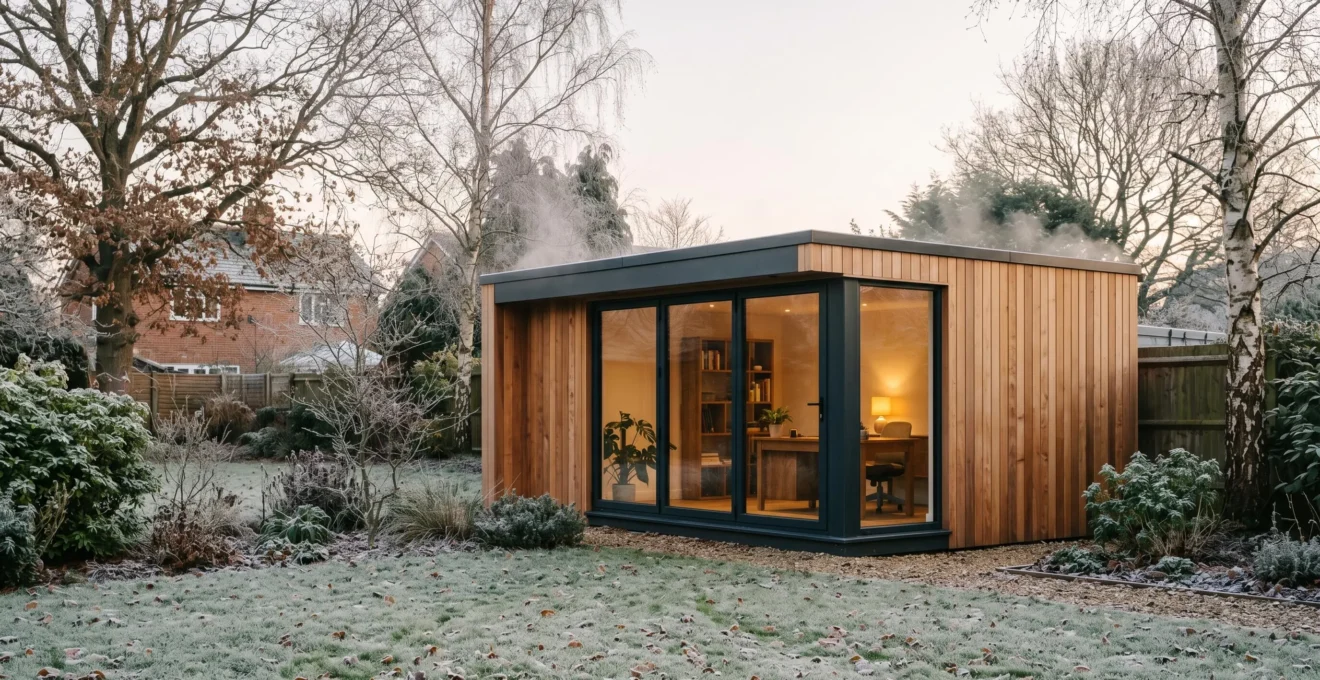
Building a successful year-round garden office is less about DIY and more about architectural systems thinking.
- Prioritise the ‘unseen’ infrastructure: a complete thermal envelope for winter, layered security compliant with insurance standards, and a robust data connection.
- Treating the build as a strategic asset, not an expense, unlocks significant benefits in property value and potential UK tax reliefs.
Recommendation: Shift your focus from the ‘box’ to the integrated systems within it. This architectural approach is the key to creating a truly high-performance workspace that serves you all year.
The siren call of the kitchen table has faded. What began as a temporary solution for remote work has, for many, become a daily battle against distractions and ergonomic nightmares. The constant interruptions, the clutter of daily life, and the lack of a clear boundary between work and home aren’t just inconvenient; they are actively draining your focus and well-being. Many consider a simple “shed” in the garden, but this often leads to a cold, insecure, and ultimately unused space.
The common advice to “buy a good shed” or “just get it insulated” dangerously oversimplifies the task. But what if the key to a successful garden office wasn’t in the structure itself, but in the unseen systems that bring it to life? This guide adopts the perspective of a workspace designer, focusing on the integrated principles that transform a simple outbuilding into a high-performance productivity sanctuary. We will explore how to think like an architect, considering the thermal envelope, data infrastructure, security layers, and financial strategy that make a garden office a true asset, both for your work and your property.
This comprehensive guide provides a blueprint for UK remote workers, navigating the crucial decisions that lead to a successful year-round garden office. From the science of insulation to the nuances of tax claims, we will cover the essential elements for creating a space that inspires deep work and adds lasting value.
Summary: Your Blueprint for a High-Performance Garden Office
- Why Working at the Kitchen Table Is Destroying Your Focus?
- How to Insulate a Shed So It Doesn’t Freeze in January?
- Prefab Pod or Custom Build: Which Adds More Value to Your Property?
- The Security Flaw in Most Garden Offices That Thieves Love
- How to Claim Tax Relief on Your Garden Office Construction?
- Why Timber Frame Walls Are 30% Thinner for the Same Insulation?
- 5G vs Fibre: Which Is Better for Zoom Calls and Gaming?
- Is 5G Home Broadband a Viable Alternative to Fibre in Rural UK?
Why Working at the Kitchen Table Is Destroying Your Focus?
The shift to remote work was abrupt for many, turning kitchen tables and spare rooms into makeshift offices. While convenient at first, this lack of a dedicated workspace has a measurable, negative impact. Research reveals a stark reality: 72% of remote workers do not have a dedicated office space, leaving them vulnerable to the constant ‘pop-in’ distraction and the psychological burden of never truly leaving work. This blurring of boundaries is a primary driver of burnout and reduced productivity, as the brain struggles to switch contexts between professional duties and domestic life.
The cost isn’t just mental. Poor ergonomics associated with non-professional setups have led to a surge in physical ailments. This hidden crisis in well-being is something experts are increasingly vocal about. As workplace wellness educator Krys Hines noted in Fortune Magazine:
remote work has aged our bodies by about 10 to 15 years
– Krys Hines, Fortune Magazine
Conversely, the benefits of creating a separate, dedicated “productivity sanctuary” are profound. It provides the psychological separation needed to engage in deep work, signaling to your brain that it is time to focus. Companies have reported a significant uptick in efficiency, with some seeing up to a 40% increase in remote worker productivity when a dedicated workspace is established. A garden office is not merely an extra room; it’s a purpose-built tool for focus, creating a physical and mental commute that restores the vital separation between work and home.
How to Insulate a Shed So It Doesn’t Freeze in January?
The difference between a summer-only shed and a genuine year-round office lies in its thermal envelope. In the UK, this isn’t a luxury; it’s a necessity. Without proper insulation, a garden office will be an icebox in winter and an oven in summer, rendering it useless for productive work. The goal is to create a sealed, continuous barrier that prevents heat from escaping in winter and entering in summer. This involves more than just stuffing some material in the walls; it requires a systematic approach to the roof, walls, and floor.
High-performance insulation materials like Polyisocyanurate (PIR) boards are central to modern construction. Their rigid, closed-cell foam structure provides an exceptional thermal barrier with minimal thickness, which is crucial for maximizing internal space. The foil backing on these boards also acts as a vapour control layer, preventing condensation and moisture-related issues that can damage the structure and your equipment.
As the visual detail above illustrates, the quality of the material and its installation are paramount. Every joint, corner, and edge must be meticulously sealed to achieve an airtight structure. This architectural attention to detail is what defines a high-performance workspace, ensuring stable temperatures and low running costs throughout the year. The following steps outline the core principles for achieving a complete thermal envelope.
Your Action Plan: Creating a Complete Thermal Envelope
- Points of contact: Begin with the roof, the primary source of heat loss and condensation, using PIR boards or multi-layer foil insulation.
- Collecte: Fit rigid PIR boards snugly between the wall frames, ensuring no gaps exist between structural elements.
- Cohérence: Seal all board edges and joints with aluminium foil tape to create a continuous, unbroken vapour barrier, preventing moisture ingress.
- Mémorabilité/émotion: Insulate the floor by laying PIR boards underneath a layer of plywood or OSB, creating a warm, stable base that eliminates cold from the ground.
- Plan d’intégration: Install an internal lining (like OSB or insulated plasterboard) over the insulation to protect it and provide a finished, durable surface.
Prefab Pod or Custom Build: Which Adds More Value to Your Property?
Once you commit to creating a garden office, a fundamental choice emerges: the speed and simplicity of a prefabricated pod versus the bespoke nature of a custom build. This decision has significant implications not just for your budget and timeline, but for the long-term value of your property. A prefab pod offers a turnkey solution, often assembled in days, but its generic design may not complement your home’s architecture. A custom build, while slower and more involved, can be designed as a true extension of your home’s aesthetic and functional character.
From an investment perspective, this distinction is critical. While any functional garden office is an attractive feature to a potential buyer, a custom build that is compliant with Building Regulations is more likely to be seen by surveyors as quantifiable, habitable square footage. This translates into a more direct and substantial impact on your home’s valuation. Indeed, property experts suggest that a high-quality, well-designed garden office can add between 5% and 15% to a home’s resale value, with custom builds often performing at the higher end of this range.
The choice ultimately depends on your priorities: speed and upfront cost versus customization and long-term asset value. The following table breaks down the key differences to help guide your decision-making process.
| Factor | Prefab Pod | Custom Build |
|---|---|---|
| Build Time | Faster: Delivered in sections and quickly assembled on-site | Slower: Typically 2-3 weeks minimum for straightforward construction |
| Customization | Limited: Standard designs with minimal adaptation options | Unlimited: Fully bespoke floor plan, cladding, and interior layout |
| Aesthetic Integration | Generic appearance may not match existing property architecture | Can be designed to match main house materials (brick, render, slate roof) |
| Cost Range | £2,500 – £8,000 for basic units | £10,000+ depending on size and specification |
| Property Value Impact | May not be recognized as habitable square footage by surveyors | More likely to add quantifiable, bankable value if Building Regulations compliant |
| Future Flexibility | Limited: Difficult to modify or expand | High: Can include roughed-in plumbing, reinforced walls for alternative uses |
The Security Flaw in Most Garden Offices That Thieves Love
A garden office is a prime target. It’s detached from the main house and filled with high-value equipment like laptops, monitors, and cameras. The single biggest security flaw in most garden offices isn’t a weak lock; it’s an amateur approach to security. Homeowners often focus on a single point, like the door, while ignoring the complete system of vulnerabilities that professional thieves are trained to spot. The most common weak points are standard uPVC patio doors, windows with simple catches, and exposed hinges—all of which can be defeated in seconds.
A professional, architectural approach treats security as a series of integrated layers, designed to deter, resist, and alert. This begins at the specification stage. Instead of asking for “secure doors,” you should be specifying doors and windows that meet rigorous, independent standards. In the UK, the police-preferred specification ensures that doors and windows tested to withstand attack should meet PAS 24:2022 certification. This standard guarantees that the entire unit—frame, locks, glazing, and hinges—has been tested against common burglary methods.
Beyond the physical hardware, a robust security strategy incorporates multiple overlapping measures. This layered approach creates a formidable barrier that makes your garden office a far less attractive target. Key elements of this strategy include:
- Deterrence: Visible elements like security cameras and motion-activated floodlights that make thieves feel exposed before they even approach.
- Physical Barriers: Specifying PAS 24 certified doors with multi-point locking systems and laminated glass, which holds together even when shattered.
- Detection and Alerting: Using contact sensors on doors/windows and internal motion detectors linked to a monitored alarm system.
- Perimeter and Policy: Ensuring garden boundaries are secure and, crucially, verifying your home insurance policy covers outbuildings to the value of your equipment, as many require PAS 24 standards for a claim to be valid.
How to Claim Tax Relief on Your Garden Office Construction?
Viewing your garden office as a strategic business asset opens up significant financial advantages, particularly for self-employed professionals and limited company directors in the UK. While the cost of the basic structure is typically not tax-deductible, HMRC’s rules on “plant and machinery” allow you to claim capital allowances on many of the integrated systems that make the office functional. This is a crucial distinction that can dramatically reduce the net cost of your project.
Effectively, you can claim tax relief on the components that are essential for the operation of your business within the space. This includes the entire electrical wiring system, plumbing, heating, data cabling, and even the thermal insulation itself. Furthermore, all furniture and equipment purchased for the office, such as desks, chairs, and computers, are also eligible. For those who are VAT-registered, there’s often the potential to reclaim the 20% VAT on the entire build and fit-out cost, representing a substantial upfront saving.
Navigating these claims requires careful record-keeping and a clear understanding of what qualifies. It is always advisable to consult with an accountant to ensure compliance and maximize your claim. The following example illustrates how these rules can be applied in practice.
Case Study: Capital Allowances for a UK Garden Office
For self-employed professionals operating as limited companies in the UK, while the structure itself of a garden office cannot be claimed for tax relief, significant portions of the build can be claimed as capital allowances under ‘plant and machinery.’ This includes electrical wiring systems, plumbing installations, heating systems, thermal insulation materials, and data cabling infrastructure. A study by IPSE shows that all office furniture and equipment can also be claimed. Additionally, repair costs can be claimed as allowable business expenses alongside ongoing utilities. For VAT-registered sole traders or limited companies, it’s often possible to reclaim the 20% VAT on the entire build and fit-out cost, representing substantial upfront savings. However, specialist tax advice should always be sought to ensure maximum relief without compliance issues.
Why Timber Frame Walls Are 30% Thinner for the Same Insulation?
The secret to a spacious-feeling garden office often lies in the thickness of its walls. In traditional blockwork construction, insulation is added as an afterthought, creating thick, cumbersome walls that eat into valuable floor space. Modern timber frame construction, however, integrates the insulation directly into the structural cavity. This architectural synergy is what allows for significantly thinner walls while achieving superior thermal performance.
The science behind this lies in the thermal conductivity of the materials, measured by their Lambda value (W/mK). A lower Lambda value means better insulation. High-performance PIR insulation, commonly used in timber frames, has a much lower Lambda value than traditional materials like mineral wool. Research shows that with a Lambda value of 0.022 W/mK, PIR is roughly twice as effective as mineral wool (0.044 W/mK), meaning you need only half the thickness to achieve the same level of insulation.
This isn’t just a technical detail; it has profound practical implications, especially in the context of UK planning laws. Garden offices are often built under “Permitted Development” rights, which impose strict limits on the building’s external footprint. By using a timber frame with high-performance PIR insulation, you can design a wall that is 30-40% thinner than a traditional build for the same U-value (the overall measure of heat loss). On a typical 4m x 3m garden office, this can recover as much as 0.5 square metres of internal, usable floor space. It’s the difference between a cramped desk area and a comfortable, functional workspace with room for storage—a critical advantage when every centimetre counts.
5G vs Fibre: Which Is Better for Zoom Calls and Gaming?
For a high-performance workspace, the internet connection is non-negotiable. The two main contenders for a garden office are Fibre-to-the-Premises (FTTP) and 5G Home Broadband. While both can offer high download speeds, their underlying technologies make them suitable for very different tasks. The key differentiators are latency and stability.
Latency, or ping, is the time it takes for a data packet to travel from your device to a server and back. For real-time applications like video calls (Zoom, Teams) and online gaming, low latency is far more important than raw download speed. A high-latency connection results in lag, audio dropouts, and a frustrating “you-go-first” delay on calls. Fibre optic cables transmit data at the speed of light, resulting in exceptionally low and stable latency, typically under 10ms. This makes it the undisputed champion for any activity requiring real-time interaction.
5G, on the other hand, is a wireless technology. While capable of high speeds, its latency is inherently higher and more variable than fibre, often ranging from 20ms to 50ms or more. This is because the signal has to travel through the air to a cell tower, where it is subject to interference, network congestion, and even weather. For streaming video or downloading large files, this is perfectly adequate. However, for a crucial client Zoom call or a competitive gaming session, that variable latency can be the difference between a seamless experience and a digital disaster. For a truly professional-grade connection, fibre provides the stability and low latency that 5G cannot yet guarantee.
Key Takeaways
- Think in systems, not components: A high-performance office integrates thermal, security, and data systems from the start.
- Invest in the ‘unseen’: The quality of insulation, the certification of doors, and the stability of your internet are more critical than cosmetic finishes.
- Design for value, not just cost: A well-designed, custom-built office is a strategic asset that enhances productivity, property value, and offers significant tax advantages.
Is 5G Home Broadband a Viable Alternative to Fibre in Rural UK?
While fibre remains the gold standard for connectivity, its availability in rural parts of the UK can be patchy and expensive to install. This has positioned 5G home broadband as a seemingly attractive alternative, promising fibre-like speeds without the need for physical cables. The growing demand for reliable connections is clear; research indicates that about 40% of remote workers have already upgraded their home internet to cope with the demands of their job. For those in the countryside, 5G can be a viable solution, but it comes with critical caveats.
Unlike a fixed fibre line, 5G performance is highly dependent on environmental factors. Provider coverage maps are often optimistic and don’t account for local topography. A hill, a dense cluster of trees, or even the thick walls of a neighbouring building can significantly degrade or block the high-frequency signals. Performance can also fluctuate based on network congestion during peak hours and can be affected by adverse weather like heavy rain or snow.
Therefore, evaluating 5G’s viability for your rural garden office requires a more thorough, hands-on approach than simply checking a website. A systematic evaluation is essential before committing:
- Verify True Coverage: Use Ofcom’s official checker, not just provider maps, and be aware of potential line-of-sight obstructions between you and the nearest cell tower.
- Trial Before You Commit: Insist on a trial period or a test device to measure real-world performance at your specific location.
- Test at Peak Times: Check connection speeds and stability during evening hours (6-10 PM) when local network contention is at its highest.
- Assess Weather Impact: Monitor the connection quality during periods of heavy rain or fog to understand its susceptibility to atmospheric conditions.
- Consider a Hybrid Strategy: For absolute business continuity, the ultimate professional solution is a “belt and braces” approach: use the best available fibre (FTTP or FTTC) as your primary line, with a 5G router and external antenna configured as an automatic failover backup.
Your high-performance workspace is more than just a building; it’s a foundation for your best work. By applying these architectural principles, you can create a strategic asset that delivers value for years to come. Start designing your productivity sanctuary today by assessing your core infrastructure needs.