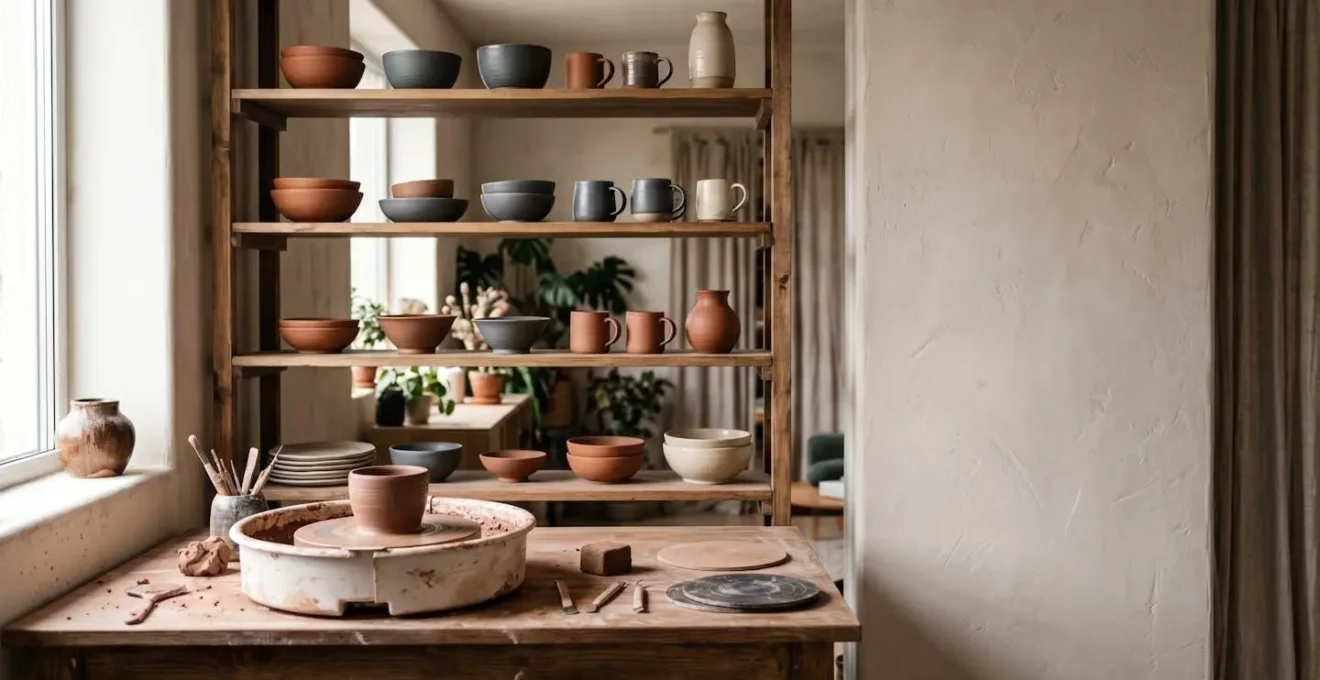
The fear of tax and complex business rules shouldn’t stop you from earning money from your creative passion.
- The UK’s £1,000 Trading Allowance is a purpose-built ‘sandbox’ for you to test selling your pottery without needing to register with HMRC.
- True profitability comes from understanding the hidden costs, from Etsy fees to your own ‘failed’ pieces, not just basic material costs.
- Protecting your unique designs with proactive documentation is as crucial as mastering your throwing technique.
Recommendation: Start small by tracking all sales and even barter transactions, price your work to reflect its true value, and keep a simple record of your creative process from day one.
That collection of beautiful, hand-thrown pots gathering dust on your shelves represents more than just a hobby. It’s a tangible expression of your skill, time, and creative spirit. You’ve thought about selling them, perhaps on Etsy or at a local market, but a wave of questions immediately follows. Do I need to register as a business? How do I handle tax? What if I only sell a few pieces? For many creatives, the administrative burden feels so overwhelming that the dream of a small side hustle dies before it even begins.
Most advice jumps straight to “set up an Etsy shop” or “calculate your costs,” but it often misses the most critical first step: understanding the mindset shift from hobbyist to seller. It’s not about becoming a corporation overnight. It’s about learning the handful of rules that allow you to explore the commercial potential of your craft safely and legally. The real key isn’t found in complex accounting software, but in grasping the difference between casual selling and demonstrating “commercial intent” in the eyes of HMRC.
This guide is designed from the perspective of a cautious advisor for creatives. We will demystify the one rule that matters most—the £1,000 trading allowance—and treat it not as a simple limit, but as your strategic launchpad. We’ll move beyond generic advice to explore the real-world financial and legal decisions you’ll face, from the true cost of an online sale to the copyright mistake that can jeopardise your passion project. By the end, you’ll have a clear framework for turning your hobby into a rewarding, and correctly managed, side hustle.
This article will provide a clear roadmap, covering everything from the foundational tax rules to the practicalities of selling online and protecting your work. Let’s explore how to navigate this journey with confidence.
Contents: Your Guide to a Profitable Pottery Side Hustle
- Why You Don’t Need to Declare Your First £1,000 of Craft Sales?
- How to Set Up an Etsy UK Shop That Converts Visitors into Buyers?
- Local Craft Market or Online Store: Which Yields Higher Margins?
- The Copyright Mistake That Gets Etsy Shops Banned Overnight
- How to Calculate Your Hourly Rate to Avoid Working for Pennies?
- Why You Might Pay Tax on Crypto Swaps Even If You Didn’t Cash Out?
- Why Your AI Content Sounds Robotic and How to Fix It?
- How to Use Generative AI to Write a Month of Social Content in 1 Hour?
Why You Don’t Need to Declare Your First £1,000 of Craft Sales?
The single most important concept for any budding UK-based creator to understand is the Trading Allowance. This isn’t a loophole; it’s a specific tax exemption designed by HMRC to simplify life for individuals with small-scale earning activities. In essence, you can earn up to £1,000 of gross income from self-employment or casual services in a tax year without having to register with HMRC or declare it on a tax return. This is your government-approved sandbox to test the waters of selling your pottery.
This is becoming an increasingly common path. A recent survey revealed that an estimated 4.9 million UK side hustlers will complete a Self-Assessment tax return for the first time by 2026, showcasing a massive shift towards monetizing skills. The £1,000 allowance is the first step on this journey. “Gross income” is the key term here—it means your total revenue *before* any expenses are deducted. If you sell 34 pots at £30 each, you’ve earned £1,020 in gross income and have crossed the threshold, even if your material costs were £500.
However, the allowance only applies if your activity is considered “trading.” If you’re simply selling a few unwanted personal items, that’s generally not a trade. HMRC uses a set of principles called the “Badges of Trade” to determine if your activity shows commercial intent. The more “yes” answers you have to questions like “Are you trying to make a profit?” and “Are your transactions frequent and systematic?”, the more likely you are to be considered a trader. Staying within the hobbyist framework means keeping your activity occasional and your primary motive as personal enjoyment, not profit.
Once your gross income from selling crafts exceeds £1,000 in a tax year (April 6th to April 5th), you are legally required to register as a sole trader with HMRC and file a Self Assessment tax return. But until then, you can experiment, learn, and sell with peace of mind.
How to Set Up an Etsy UK Shop That Converts Visitors into Buyers?
Once you’re ready to start selling, Etsy is the natural first port of call for many crafters. It offers immediate access to a massive, motivated audience, with the platform boasting over 92 million active buyers. However, this access comes at a price. Turning visitors into buyers requires more than just beautiful photos; it demands a clear understanding of the platform’s fee structure so you can price your work for actual profit, not just revenue.
As a cautious advisor, my first step with any creative is to demystify the costs. It’s easy to see a £30 sale and feel successful, but the reality is that multiple fees are deducted before that money ever reaches your bank account. These include listing fees, transaction fees, payment processing fees, and in the UK, a specific Regulatory Operating Fee. For a creative just starting out, these small percentages can quickly erode the £1,000 trading allowance you’re trying to manage.
To make this tangible, let’s break down exactly what happens when you sell a £30 pot on Etsy in the UK. The following table illustrates how quickly the fees add up, showing the “true cost of sale” on the platform.
| Fee Type | Rate/Amount | Cost per £30 Pot |
|---|---|---|
| Listing Fee | £0.16 per item | £0.16 |
| Transaction Fee | 6.5% of total sale | £1.95 |
| Payment Processing Fee | 4% + £0.20 | £1.40 |
| Regulatory Operating Fee (UK) | 0.25% of total | £0.08 |
| Total Etsy Fees | — | £3.59 (11.97%) |
| Your Net Revenue | — | £26.41 |
| To reach £1,000 gross income: Sell 34 pots at £30 each. Your net after Etsy fees: £898.94 | ||
This breakdown shows that nearly 12% of your sale price is consumed by fees. To earn £1,000 in gross revenue, you’d need to sell 34 pots, but you would only pocket about £899. Understanding this fee leakage is the first step to setting up a shop that is genuinely profitable and sustainable.
Beyond fees, conversion on Etsy relies on high-quality photography that shows scale and texture, detailed descriptions that tell the story of the piece, and transparent shipping policies. Think of your Etsy shop not as a simple gallery, but as your digital market stall where trust and clarity lead to sales.
Local Craft Market or Online Store: Which Yields Higher Margins?
The Etsy-versus-market debate is a classic crossroads for any artisan. One offers global reach from your sofa; the other provides face-to-face connection and instant cash. But the decision on where to sell your pottery shouldn’t be based on convenience alone. From a financial perspective, the most important question is: which channel allows you to keep more of your hard-earned money? The answer lies in comparing the true cost per sale for each option.
An online store like Etsy operates on a variable cost model—you primarily pay when you make a sale. A local craft market, however, is a fixed-cost model. You have significant upfront expenses (stall fees, travel, payment hardware) before you’ve sold a single piece. You are betting on making enough sales on the day to cover those costs and turn a profit. For a handmade business, a healthy net profit margin of 20-40% is considered solid, and your choice of sales channel will directly impact your ability to hit that target.
Let’s compare the real-world costs of selling a £30 pot at a typical UK craft market versus on your Etsy store, assuming you sell 20 items. This analysis reveals where your money really goes.
| Cost Category | Local Craft Market | Etsy Online Store |
|---|---|---|
| Upfront/Fixed Costs | Stall fee: £50-£150 Travel: £20-£60 Meals: £15-£30 |
None (pay per transaction) |
| Per-Sale Variable Costs | Card reader fee: 1.75-2.9% Time at event: 8-10 hours |
Listing: £0.16 Transaction: 6.5% Processing: 4% + £0.20 Regulatory: 0.25% |
| Per-Sale Packaging | Minimal (hand to customer) | Box: £1-£2 Protective material: £0.50-£1 Label/printing: £0.30 |
| Shipping Cost (absorbed or passed on) | £0 | £3.50-£5.50 |
| Total Cost Example (£30 item, 20 sales) | Fixed: £100 Variable: £10.50 Total: £110.50 (£5.53/unit) |
Fixed: £0 Fees per unit: £3.59 Packaging: £2.00 Shipping materials: £2.00 Total: £7.59/unit |
| Net Revenue per £30 Sale | £24.47 | £22.41 (if shipping passed to customer) |
| Retail margin target for craft businesses: 45-55% to remain profitable | ||
As the table shows, the local craft market yields a higher net revenue per item in this scenario, primarily due to the absence of significant packaging and shipping costs. However, this is entirely dependent on hitting your sales target to cover the high fixed costs. An online store offers lower risk if sales are slow but eats into your margin with fees and logistics. The best strategy is often a hybrid approach: use markets for cash flow and local brand building, and an online store for consistent, broader reach.
Ultimately, your choice should align with your goals. If you thrive on personal interaction and can confidently predict sales volume, markets may be more profitable. If you value flexibility and a lower-risk start, an online store is the clear winner, provided you price your items to absorb the associated costs.
The Copyright Mistake That Gets Etsy Shops Banned Overnight
In the world of handmade goods, your creativity is your most valuable asset. But many new sellers make a catastrophic mistake: they assume that because their work is handmade, it’s automatically protected, or that “inspiration” is a defense against copyright infringement. This is dangerously naive. Etsy and other platforms take intellectual property (IP) claims very seriously, and a single complaint—justified or not—can lead to your listings being removed or your shop being permanently banned without warning.
The most common mistake is not outright copying, but sailing too close to another artist’s protected design or a trademarked character. Using phrases like “inspired by Disney” or creating a mug that closely resembles a famous design can trigger an automated IP takedown. The burden of proof then falls on *you* to demonstrate that your work is original. Without evidence, it’s your word against a corporation’s, and platforms will almost always side with the established rights holder.
This is why, as an advisor, I stress the importance of Defensive Documentation. It’s a proactive process of creating a time-stamped, visual record of your creative journey for each design. This isn’t about legal paperwork; it’s about building a file of evidence that proves your idea was developed independently. It is your single best defense against a false claim.
As shown in the image, this process starts long before the final piece emerges from the kiln. It involves documenting your very first sketches, your works-in-progress, and any unique tools or glaze recipes you develop. This visual diary becomes your shield. If a claim is ever made, you can present a clear, dated history of your design’s evolution, proving it’s the product of your own creative labour, not a copy.
- Initial Sketch Phase: Photograph or scan your earliest design concepts with date stamps.
- Work-in-Progress Documentation: Take photos at each major stage—leather-hard clay, bisque-fired, glazed unfired, final piece.
- Tool and Technique Records: Document your unique tools, custom stamps you created, and proprietary glaze recipes.
- Inspiration Source Log: Keep a separate journal noting general style influences (e.g., ‘mid-century modern aesthetic’) without directly copying specific protected designs.
- Commercial Component Check: Photograph packaging of any commercial molds, textures, or stamps with visible licensing terms.
Don’t let a preventable mistake destroy the side hustle you’ve worked so hard to build. Treat your creative process with the same seriousness as your craft, and document every step. It’s the best insurance policy you can have.
How to Calculate Your Hourly Rate to Avoid Working for Pennies?
One of the quickest ways for a pottery hobby to become a source of resentment is to realize you’re effectively working for less than minimum wage. A common pricing mistake is a simple formula: (Materials + Time) x 2. This fails to account for the hidden realities of a craft like pottery: overheads, platform fees, and most importantly, failures. Not every piece that goes into the kiln comes out perfect. Cracks, glaze flaws, and warping are part of the process, and their cost must be absorbed by the pieces that *do* sell.
To avoid this trap, you need to calculate a value-based hourly rate and build a pricing structure that is resilient to failure. This starts with setting a realistic minimum hourly rate for your labour. What do you *need* to earn per hour to make this worthwhile? Then, you must factor in the inherent failure rate of your craft. If one in every five pieces fails, you have to make the four successful pieces cover the cost and time invested in all five. This is the “Kiln-Failure Multiplier.”
This approach moves you from a simplistic cost-plus model to a professional pricing strategy. Here is a step-by-step method to build your price from the ground up, ensuring every sale contributes meaningfully to your income.
- Track Your Failure Rate: Over 20-30 firings, calculate the percentage of pieces that crack, warp, or develop glaze defects (a typical range is 10-25%).
- Calculate Sunk Cost Per Failure: Add the material cost and labor hours invested in a failed piece before discovering the flaw.
- Determine Success Multiplier: If 20% of your pieces fail, your multiplier is 1.25 (you must make 5 pieces to successfully sell 4).
- Apply to Material Costs: Multiply your clay, glaze, and firing costs by your failure multiplier (e.g., £8 materials × 1.25 = £10 real material cost per successful piece).
- Set Minimum Hourly Rate: Calculate your desired monthly income divided by available production hours (e.g., £1,500 ÷ 80 hours = £18.75/hour minimum).
- Build Final Price: (Adjusted Material Cost + [Labor Hours × Hourly Rate] + Overheads) × Markup.
The final step is the markup, which covers your profit and business growth. For direct-to-consumer retail, markup ranges between 100-300% (a 2-3x multiplier) are standard. A 2x markup is a good starting point for a new seller. This ensures you’re not just covering costs, but are actually building a profitable enterprise.
Pricing your work correctly is an act of self-respect. It validates your skill, time, and creative investment. Don’t fall into the trap of under-valuing your art; build a price that reflects its true worth and allows your hobby to flourish financially.
Why You Might Pay Tax on Crypto Swaps Even If You Didn’t Cash Out?
As a creative individual exploring modern income streams, your financial world might extend beyond simple cash sales. It’s crucial to understand that in the UK, any form of income or value received counts towards your £1,000 trading allowance, and this includes non-cash transactions. The most common example for an artisan is a barter transaction: trading a pot for a service, like a professional photography session for your Etsy shop. The ‘income’ you’ve received is the fair market value of that photography session, and it must be tracked.
This principle of “non-cash income” extends to a more complex and often misunderstood area: cryptocurrency. You might think that tax only applies when you “cash out”—that is, sell your crypto for pounds sterling. This is a major misconception. In the UK, cryptocurrencies are treated as assets, and a taxable event (a ‘disposal’) can occur when you:
- Sell crypto for cash.
- Exchange one type of crypto for another (e.g., swapping Bitcoin for Ethereum).
- Use crypto to pay for goods or services.
That second point is what catches many people out. A crypto-to-crypto swap is a disposal of one asset to acquire another. If the asset you disposed of has increased in value since you acquired it, you may have realized a Capital Gain, which could be subject to Capital Gains Tax. This applies even if no traditional money has touched your bank account. It’s the digital equivalent of a barter transaction, and HMRC wants to know about it. For a side-hustler, keeping a meticulous record of all forms of income, cash or not, is essential for staying compliant.
Whether you’re bartering a handmade vase or swapping digital tokens, the underlying rule is the same: if you receive value in exchange for your assets or services, it has financial implications. As your creative enterprise grows, maintaining a clear log of all transactions, not just cash sales, is a non-negotiable part of responsible financial management.
Why Your AI Content Sounds Robotic and How to Fix It?
As you build your online presence, the pressure to create content—product descriptions, social media posts, blog articles—can be immense. It’s tempting to turn to Artificial Intelligence (AI) to speed things up. But here lies a critical paradox for the artisan: the very tool you use for efficiency can strip your brand of its most valuable asset: its human touch. AI content often sounds robotic because it’s designed for logical precision, not emotional resonance. It defaults to generic adjectives, predictable sentence structures, and a polished perfection that feels sterile and inauthentic.
For a potter, this is poison. Your customers aren’t just buying a container; they are buying a story, a piece of your time, and the beauty of imperfection. They value the slight asymmetry of a rim, the visible thumbprint where the handle joins the body, the unique way the glaze breaks over a curve. These are what I call “authenticity signals”—the tangible proof of a human hand at work. Robotic, perfect AI-generated text sends the exact opposite signal. It creates a jarring disconnect between the organic, tactile nature of your product and the sterile words used to describe it.
The solution isn’t to abandon AI, but to fundamentally change your relationship with it. Stop using it as a writer and start using it as an assistant. The key is to inject your own humanity and unique perspective *into* the process. Instead of asking it to “write a description for a blue mug,” you provide it with the raw, emotional, and sensory details only you know. Feed it your story, the feeling of the clay, the inspiration behind the glaze. Use it to structure your thoughts or brainstorm metaphors, but always perform the final edit yourself, re-reading every line to ensure it sounds like *you*.
Your voice is as unique as your pottery. Don’t let a machine flatten it into something generic. Use AI as a tool to amplify your message, not to create it. The ‘fix’ for robotic content is simple: more you.
Key Takeaways
- The UK’s £1,000 Trading Allowance is your legal ‘sandbox’ to test selling without registering with HMRC, but it’s based on gross income, not profit.
- Success on platforms like Etsy depends on pricing for ‘true cost,’ including fees, packaging, and a multiplier for failed pieces, not just materials and time.
- Protect your most valuable asset—your originality—with ‘Defensive Documentation’ by creating a time-stamped visual record of your creative process.
How to Use Generative AI to Write a Month of Social Content in 1 Hour?
After understanding the risk of AI-generated content sounding robotic, the next step is to master its strategic use. The power of Generative AI for an artisan isn’t to replace your voice, but to structure your thoughts and scale your marketing efforts, allowing you to spend more time creating and less time staring at a blank screen. With the right approach, you can generate a full month’s worth of social media ideas and drafts in a single, focused one-hour session.
The secret is moving away from simple, generic prompts and toward a “Master Prompt” that teaches the AI who you are. This involves defining your specific brand voice, your target audience, and the content themes that resonate with your craft. By providing this context upfront, you guide the AI to generate content that is already 80% of the way there, leaving you to simply perform the final 20% of editing to inject your personal stories and “authenticity signals.”
This batching method transforms content creation from a daily chore into a manageable, once-a-week or once-a-month task. Below is a practical plan to build your AI-powered content engine, focusing on creating prompts that deliver high-quality, relevant drafts that you can quickly refine and make your own.
Your Action Plan: AI-Powered Content Calendar for Artisans
- Master Prompt Template: Start with a detailed prompt that defines your entire strategy. Example: ‘Act as a social media strategist for a handmade pottery business in the UK. My brand voice is warm, rustic, and celebrates imperfection. My target audience is 30-45 year old homeowners who value sustainability. Create a 4-week content calendar with themes for The Process, Meet the Maker, Styling Tips, and Community Spotlight. For each post, provide a hook, caption, and hashtags.’
- Product Story Generator: Feed the AI bullet points about a specific piece. Prompt: ‘Take these facts about my ceramic mug: [your notes]. Transform them into a short, poetic story (100 words) for an Etsy listing that begins with a sensory detail and includes an unexpected metaphor.’
- FAQ Automation: Prepare for customer questions. Prompt: ‘List the 10 most common questions a pottery buyer on Etsy UK might ask. For each, write a friendly, concise answer (under 50 words) that builds confidence.’
- Design Inspiration Prompt: Use AI for creative brainstorming. Prompt: ‘Generate 5 pottery design concepts inspired by the theme of “stormy seas on the Cornish coast.” Describe form, texture, and glaze palette for each, and the mood it should evoke.’
- Weekly Batch Creation: Dedicate one hour to run all your prompts for the upcoming weeks. Spend the next 30 minutes editing the outputs, removing generic phrases, and adding personal anecdotes to make the content truly yours.
This system allows you to maintain a professional and active social media presence, build a community around your work, and drive sales, all without sacrificing precious hours that could be spent at the potter’s wheel. It’s the ultimate side-hustle efficiency hack.