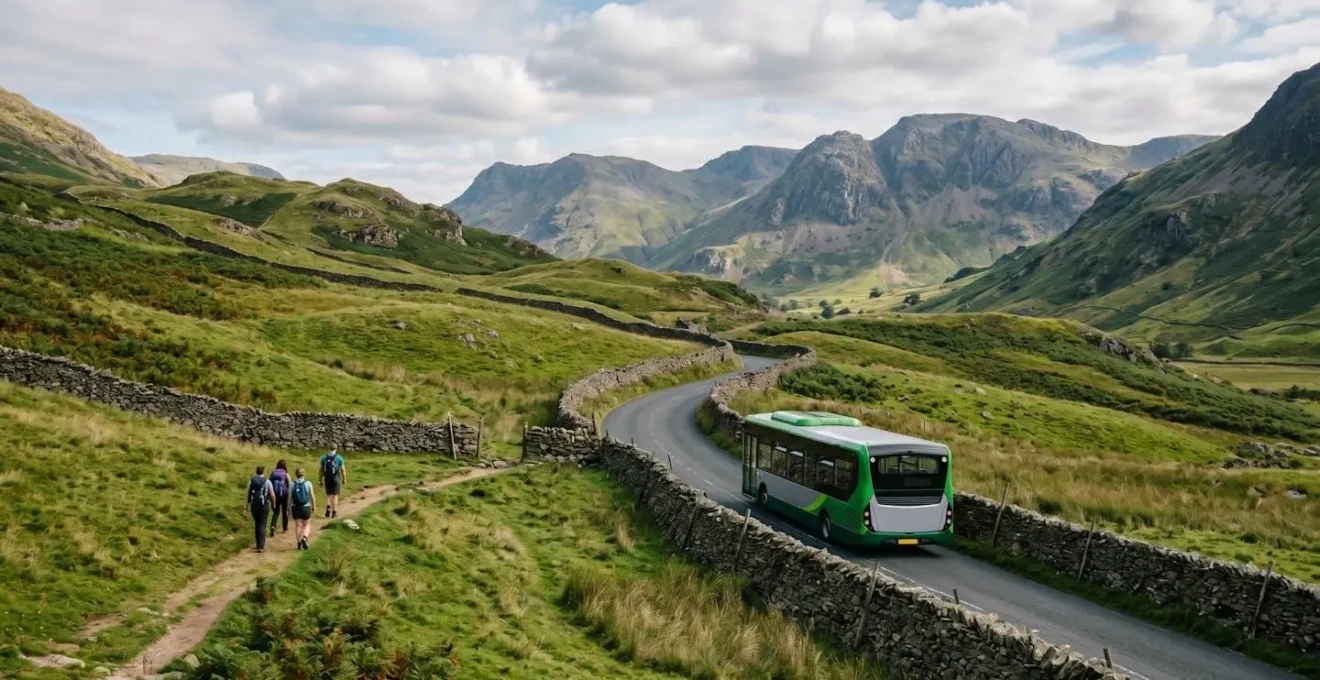
Swapping your car for public transport in the Lake District isn’t a compromise—it’s a significant upgrade to your entire holiday experience.
- You gain operational freedom for point-to-point hikes and avoid the stress and hidden costs of parking.
- You directly support local economies and reduce your environmental impact on the fragile landscape.
Recommendation: Focus on the “total value” of your trip by factoring in reduced stress and unique experiences, not just the upfront ticket price.
Picture the scene: a breathtaking Lake District panorama unfolds before you, the promise of a perfect hike ahead. Now, picture that vision being shattered by an hour spent circling a full-to-bursting car park, the engine idling as frustration mounts. For many, this is the unfortunate reality of visiting one of the UK’s most cherished landscapes. The sheer volume of cars gridlocks narrow lanes, strains village infrastructure, and turns a peaceful escape into a stressful ordeal.
The common advice—”take the train” or “use the bus”—is often heard, but frequently dismissed as a second-best option, a narrative of inconvenience and compromise. We’re conditioned to believe that freedom lies in having our own vehicle at the door. But what if this assumption is fundamentally flawed? What if ditching the car is the very key that unlocks a more authentic, less stressful, and ultimately superior Lake District experience?
This guide is built on that premise. We will reframe the car-free journey not as a sacrifice, but as a strategic choice for a better holiday. It’s about an experience upgrade. It’s about discovering the true rhythm of the Lakes, a pace dictated by the gentle chug of a lake steamer or the scenic route of a double-decker bus, rather than the frantic search for a parking space.
Throughout this article, we will explore the practical steps and mindset shift required to embrace this approach. We’ll show you how to leverage the integrated transport network, support the very communities you’ve come to admire, choose the perfect time to visit for genuine tranquillity, and understand the profound value that comes from travelling thoughtfully and sustainably.
Summary: Your Guide to a Car-Free Lake District Adventure
- Why Staying in Locally Owned B&Bs Supports the Village Economy?
- How to Explore Windermere and Ambleside Entirely by Bus and Boat?
- Wild Camping or Campsite: Where Can You Legally Sleep in the Lakes?
- The Footpath Erosion Caused by Tourists Taking Shortcuts
- When to Visit the Lakes to Avoid the Summer Tourist Crush?
- Filter or Boil: How to Avoid Buying 50 Plastic Bottles on the Trail?
- Why Flying to Edinburgh Emits 5x More CO2 Than Taking the Train?
- Why Taking the Train to Europe Costs More But Offers Better Value?
Why Staying in Locally Owned B&Bs Supports the Village Economy?
Your sustainable journey begins the moment you book your accommodation. Choosing a large, chain hotel on the outskirts might seem convenient if you have a car, but for a truly integrated, car-free trip, the locally-owned Bed & Breakfast or guesthouse is a far superior choice. When you stay local, your money circulates directly within the village economy, supporting the families who are the lifeblood of these communities. It’s the difference between being a passive observer and an active participant in the local ecosystem.
Moreover, these small business owners are often the best-kept secret of car-free travel. They are walking, talking encyclopaedias of local knowledge, perfectly positioned to provide a level of personalised, sustainable travel advice that no corporate booking site ever could. They know the bus timetables by heart, have the number for a reliable local taxi for that ‘last mile’ from the station, and can recommend a fantastic pub walk that ends right at a bus stop. Their business depends on the village thriving, and that includes making it accessible for those who arrive without a car.
Before booking, don’t hesitate to ask questions that reveal how “car-free friendly” a B&B truly is. This proactive approach not only ensures a smoother trip for you but also signals to owners that supporting sustainable travellers is a valuable business strategy. Consider this your pre-booking checklist:
- What’s your advice for guests arriving by train or bus?
- Do you offer luggage storage after check-out to allow for a final day of exploring?
- Is there a drying room for wet hiking gear? (A must in the Lakes!)
- Can you provide packed lunches for hikers?
- What’s the nearest bus stop and which key routes serve it?
By choosing an accommodation that actively welcomes and facilitates car-free travel, you’re not just booking a room; you’re investing in the resilience of the local economy and setting your trip up for success from day one.
How to Explore Windermere and Ambleside Entirely by Bus and Boat?
The idea of navigating the bustling hubs of Windermere and Ambleside without a car might seem daunting, but it’s here that the “experience upgrade” of car-free travel becomes most apparent. The Lake District boasts a remarkably integrated public transport system of buses and ferries, designed to connect key towns, attractions, and trailheads. This network doesn’t just replace the car; it offers a more scenic, relaxing, and strategically flexible way to explore.
The iconic open-top 599 bus route is a journey and a destination in itself. Winding from Bowness through Windermere, Ambleside, and on to Grasmere, it offers elevated, panoramic views of the lakes and fells that you simply cannot get from inside a car. With buses running as frequently as every 30 minutes during peak season, you can hop on and off at will, exploring lakeside paths at Brockhole, the Roman fort at Ambleside, or Wordsworth’s home at Rydal Mount. The stress of finding a parking spot is replaced by the simple joy of watching the landscape unfold from the top deck.
As the illustration above perfectly captures, the magic lies in the seamless integration between land and water. You can take a bus to Waterhead Pier in Ambleside and immediately board a Windermere Lake Cruises steamer for a stunning journey to Bowness or Lakeside. This unlocks incredible flexibility, allowing for goal-oriented itineraries that are simply impractical with a car. Instead of being tied to a single starting point, you can create linear journeys that immerse you in the landscape.
- The Beatrix Potter Trail: Take the 599 bus to Bowness, visit the World of Beatrix Potter Attraction, then hop on the Cross Lake Shuttle to Ferry House. From there, the seasonal 525 bus can take you to Hill Top, the author’s beloved farmhouse.
- A Langdale Valley Hike: Board the 516 ‘Langdale Rambler’ from Ambleside. It takes you deep into the valley to the Dungeon Ghyll hotel, the starting point for some of the most classic fell walks, including the Langdale Pikes.
- Scenic Open-Top Circuit: A perfect day out involves riding the full 599 route to Grasmere, exploring the village, and then returning via a lake cruise from Waterhead to Bowness, experiencing the same valley from two completely different perspectives.
Embracing this system isn’t about limitation; it’s about operational freedom. It’s the freedom to enjoy a pint at a pub after a long hike without worrying about who’s driving, and the freedom to let the journey itself become a memorable part of your adventure.
Wild Camping or Campsite: Where Can You Legally Sleep in the Lakes?
For the adventurous traveller, the allure of waking up surrounded by the fells is a powerful one. However, the dream of “wild camping” often clashes with the legal and environmental reality. It’s a common misconception that you can pitch a tent anywhere in the Lake District. In fact, the Lake District National Park Authority confirms that, unlike in Scotland, wild camping is not legally permitted in England without the explicit permission of the landowner. Every piece of land, no matter how remote it appears, is owned by someone.
While some landowners may turn a blind eye to a responsible camper who pitches late, leaves early, and leaves no trace, this informal tolerance is under increasing strain due to overuse and irresponsible behaviour. For the eco-conscious traveller, the most sustainable and respectful choice is to use designated campsites. This doesn’t mean sacrificing your car-free principles. Many of the National Park’s best campsites are strategically located and surprisingly accessible via public transport, offering the perfect blend of wild-feeling adventure and responsible tourism.
Choosing the right campsite depends on your hiking ambitions. Here are some of the best National Trust sites, all accessible without a car:
- Great Langdale: The holy grail for serious hikers. Accessible via the 516 ‘Langdale Rambler’ bus from Ambleside, it places you at the foot of the Langdale Pikes, Bowfell, and Crinkle Crags.
- Low Wray: Situated near the shores of Windermere, this site is ideal for families and water sports enthusiasts. It’s accessible via the 555/599 bus routes and offers a gentler introduction to Lakeland camping.
- Wasdale: For those seeking to conquer England’s highest peak, Scafell Pike. This is the most remote campsite and requires more planning, accessible via the seasonal Wasdale Explorer shuttle, which connects with the train line at Ravenglass.
- Eskdale: A fantastic option for combining a love of heritage railways with hiking. This site is also served by the Wasdale Explorer shuttle from Ravenglass station, the terminus of the charming Ravenglass and Eskdale Railway.
By opting for a public transport-accessible campsite, you are making a conscious choice to support sustainable infrastructure, reduce pressure on sensitive environments, and ensure that the beauty of the Lakes can be enjoyed by generations to come.
The Footpath Erosion Caused by Tourists Taking Shortcuts
The impact of over-tourism isn’t just felt in congested roads and full car parks; it’s written into the very fabric of the landscape. One of the most visible scars is footpath erosion. The fells of the Lake District have a network of ancient, well-established paths designed to guide walkers safely while protecting the surrounding delicate ecosystem. However, when trails become overcrowded or walkers seek a “shortcut” to a popular viewpoint, they fan out onto the surrounding vegetation. This seemingly harmless act, when multiplied by millions of visitors, has devastating consequences.
The thin mountain soil and hardy-but-fragile flora are quickly trampled. Rain then washes away the exposed soil, carving ugly, widening scars into the hillside. This creates a vicious cycle: as the main path becomes a muddy channel, more people walk on the edges, making the problem even worse. It takes decades, and often significant financial investment from conservation charities, to repair this damage. Sticking to the designated path is a fundamental act of respect for the landscape.
This problem is inextricably linked to the issue of traffic. The sheer volume of visitors, often funnelled by car to a few “honeypot” locations like Catbells or the Old Man of Coniston, concentrates pressure on a small number of trails. By choosing to travel without a car, you are already part of the solution. It encourages a more distributed and thoughtful approach to exploring. You are more likely to use less-frequented paths starting from a bus stop or your B&B, spreading the load and discovering hidden gems away from the crowds.
The Lake District National Park Authority’s message is clear and connects these two issues directly, urging visitors to think holistically about their impact. As they state in their official guidance:
Help us look after this spectacular landscape by leaving the car at home, helping to reduce traffic and parking pressures, meaning you can enjoy more views and some stress-free, sustainable travel.
– Lake District National Park Authority, Getting to and around the Lake District official guidance
Every decision, from how you arrive to whether you stick to the path, contributes to the preservation of this world-class landscape. Your footprints matter—both on the fells and in your carbon footprint.
When to Visit the Lakes to Avoid the Summer Tourist Crush?
The single biggest factor influencing the quality of a Lake District visit is timing. The park’s popularity has exploded in recent years; Friends of the Lake District reports that visitor numbers grew from 14.8 million in 2012 to nearly 20 million by 2018, with the vast majority concentrated in the few short weeks of the summer holidays. This “tourist crush” is the primary driver of traffic congestion, full car parks, and footpath erosion. The most powerful strategy for a better, more sustainable trip is to simply avoid this peak period.
The “shoulder seasons” of May, June, September, and October offer the perfect sweet spot. The weather is often stable and pleasant, the landscape is arguably at its most beautiful—with spring blossoms or autumn colours—and the crowds have thinned considerably. Even the light is better, with the low sun creating more dramatic shadows and textures on the fells.
However, the most transformative shift you can make is to embrace weekday travel. The difference between a Saturday and a Wednesday in the Lakes is night and day. Visitor numbers can drop by as much as 60-70% mid-week, even during the shoulder seasons. Public transport services run just as frequently, but the buses are emptier, the trails are quieter, and the villages feel less like a theme park and more like living communities. By planning a Tuesday-to-Thursday trip, you are not only gifting yourself a more peaceful experience but also helping to spread the economic benefits of tourism more evenly throughout the week for local businesses.
Your Action Plan: The Weekday Warrior 3-Day Template
- Arrival (Tuesday): Arrive mid-morning via the train to Windermere. Settle into your car-free accommodation and take an afternoon 599 bus to Ambleside for some relaxed town exploration.
- Adventure (Wednesday): Take an early 516 bus into the Langdale valley for a full-day hike. You’ll enjoy the iconic trails with a fraction of the weekend foot traffic and return in the late afternoon.
- Culture & Departure (Thursday): Catch the morning 555 bus to Grasmere. Enjoy a leisurely visit to the village, perhaps indulging in some famous gingerbread, before starting your return journey in the afternoon, completely avoiding the weekend travel rush.
- Assess the Advantage: Note how public transport operates normally, yet you experience the park with dramatically lower visitor numbers, making every step of the journey more enjoyable.
- Plan Integration: Use this template as a base to build your next mid-week trip, swapping out locations but keeping the core principle of avoiding the weekend peak.
Ultimately, visiting the Lakes is a question of quality over quantity. A peaceful three-day trip mid-week in September can provide a far richer and more restorative experience than a frantic week in August.
Filter or Boil: How to Avoid Buying 50 Plastic Bottles on the Trail?
A commitment to sustainable travel extends beyond transport and accommodation; it influences the small, everyday choices we make on the trail. One of the most significant yet easily overlooked environmental impacts is the reliance on single-use plastic water bottles. A week-long hiking trip can easily result in dozens of empty bottles, which create a litter problem in remote areas and contribute to plastic pollution globally. For the eco-conscious traveller, carrying a reusable bottle is a given, but how do you keep it full in the fells?
The Lake District is blessed with an abundance of water. Gushing becks and tumbling gills are a quintessential part of the landscape. While it can be tempting to drink directly from a fast-flowing stream high on a mountain, it’s not without risk. Agricultural runoff and grazing animals, particularly sheep, mean that even the clearest-looking water can contain harmful bacteria like Giardia or Cryptosporidium. Buying bottled water from a village shop is not the answer.
The solution is simple, lightweight, and empowering: treat your own water. This practice liberates you from the need to carry a day’s worth of heavy water, allowing you to travel lighter and faster. There are two primary methods:
- Filtering: Modern portable water filters are a marvel of technology. Devices from brands like Sawyer, Lifestraw, or Katadyn are incredibly compact and effective, screwing directly onto a standard bottle or using a simple squeeze system. They physically remove bacteria and protozoa, providing safe, clean water instantly.
- Purifying: An alternative is to use purification tablets (chlorine or iodine) or a UV light pen like a SteriPEN. These methods kill bacteria and viruses. Tablets are the lightest option but can leave a slight taste and require a short waiting time. UV pens are quick and effective but rely on batteries.
As this image demonstrates, the process is straightforward. With a simple, pocket-sized filter, every suitable stream becomes a personal, waste-free refilling station. It’s a small change in habit that has a huge collective impact, preserving the pristine nature of the trails and reducing your personal environmental footprint.
By investing in a reusable bottle and a reliable treatment method, you are not just avoiding plastic waste; you are embracing a deeper level of self-sufficiency and respect for the natural environment you are there to enjoy.
Why Flying to Edinburgh Emits 5x More CO2 Than Taking the Train?
The journey *to* the Lake District is just as important as the travel *within* it. For visitors from London and the South East, the choice between train and domestic flight (to a nearby hub like Manchester or Edinburgh) might seem like a trade-off between time and cost. However, from a sustainable travel perspective, the choice is unequivocally clear. Train travel is vastly more efficient and less polluting than flying, and often more convenient than you think.
The core of the issue is carbon emissions. A train journey from London to the Lake District emits a fraction of the CO2 per passenger compared to a domestic flight covering a similar distance. While the H2 title mentions Edinburgh, the principle is the same for any short-haul flight. The high energy cost of take-off and landing makes these short flights incredibly inefficient. Opting for the train is one of the single most impactful decisions a long-distance visitor can make to reduce the carbon footprint of their trip.
Beyond the carbon argument, the train often wins on “total journey time” and convenience. While a flight might be just an hour in the air, you must factor in travel to a London airport, arriving 1-2 hours early for security, the flight itself, de-planing, and then onward travel from the destination airport. In contrast, the train journey is a seamless city-centre to town-centre experience. The West Coast Main Line offers a direct route, with journey times of just 2 hours and 45 minutes from London Euston to Oxenholme (The Lake District’s main station).
During that time, you are not navigating security lines or waiting in departure lounges. You are relaxing in a comfortable seat, watching the English countryside roll by, able to work, read, or simply enjoy the view. There are no luggage weight limits to worry about, and you arrive directly at a station integrated with the local bus network, ready to begin your car-free adventure. It’s a civilized, productive, and low-stress start to a holiday.
When you consider the entire door-to-door experience, the train is not just the greenest option; it’s often the smartest and most relaxing one, setting the perfect tone for a mindful exploration of the Lake District.
Key Takeaways
- Car-free travel in the Lakes is an experience upgrade, not a compromise, offering less stress and more scenery.
- The integrated network of buses and boats provides excellent, scenic access to major hubs, trails, and attractions.
- The total cost of a car-free trip is comparable to driving when all factors are considered, but the overall value is significantly higher.
Why Taking the Train to Europe Costs More But Offers Better Value?
The ultimate question for any traveller is one of value. At first glance, a train ticket can sometimes look more expensive than the cost of fuel for a road trip. This narrow comparison is the primary reason people remain tethered to their cars, overlooking the significant hidden costs and stresses of driving. To make a truly informed decision, we must compare the total cost and total value of the entire trip, not just the initial outlay.
The title’s reference to Europe highlights a broad principle: train travel often presents a higher ticket price but delivers superior value. Let’s apply this directly to a Lake District holiday. When you drive, the cost of fuel is only the beginning. You must also account for the cost of parking, which can be substantial in tourist hotspots. Then there’s the less tangible but very real cost of vehicle wear and tear. Finally, and perhaps most importantly, there is the mental cost of driving: the stress of navigating congested lanes, the constant search for parking, and the fact that one person (the driver) is always “on duty” and cannot fully relax and enjoy the scenery.
When we quantify these elements, the financial picture changes dramatically. A car-free trip, utilising trains and local bus passes, suddenly becomes not just an environmental choice, but a financially competitive one. The following comparison breaks down the estimated costs for a family trip, revealing a surprisingly small difference.
This recent analysis illustrates the true cost comparison, factoring in all the hidden expenses of driving.
| Expense Category | Car-Based Trip | Car-Free Trip |
|---|---|---|
| Transport to Lake District | Fuel: £120 (London-Windermere return, 570 miles @ 40mpg, £1.45/litre) | Train: £180 (4 x advance return tickets London-Oxenholme) |
| Local Transport | Local fuel: £40 | Stagecoach Explorer Pass (5 days): £95 (family ticket, unlimited bus travel) |
| Parking | £50 (£10/day x 5 days at various car parks) | £0 |
| Vehicle Wear & Tear | £57 (570 miles @ 10p/mile HMRC rate) | £0 |
| TOTAL | £267 | £275 |
| Cost Difference | Car-free costs only £8 more (3% difference) | |
As the table shows, the monetary cost is almost identical. However, the *value* proposition is vastly different. The car-free trip includes intangible benefits that transform the holiday:
- Stress Reduction: The designated driver is eliminated. Everyone gets to enjoy the views and relax.
- Operational Freedom: You can undertake linear, point-to-point hikes, like the Helvellyn ridge, without needing to loop back to a car park.
- Spontaneity: Everyone can enjoy a well-earned pint at a country pub after a long hike.
- Health Benefits: The “last mile” walks from bus stops to trailheads add gentle, healthy activity to your day.
Plan your next Lake District adventure with this car-free mindset. By choosing trains, buses, and local B&Bs, you not only reduce congestion but actively invest in a more relaxing, authentic, and sustainable experience for yourself and for the future of the park.