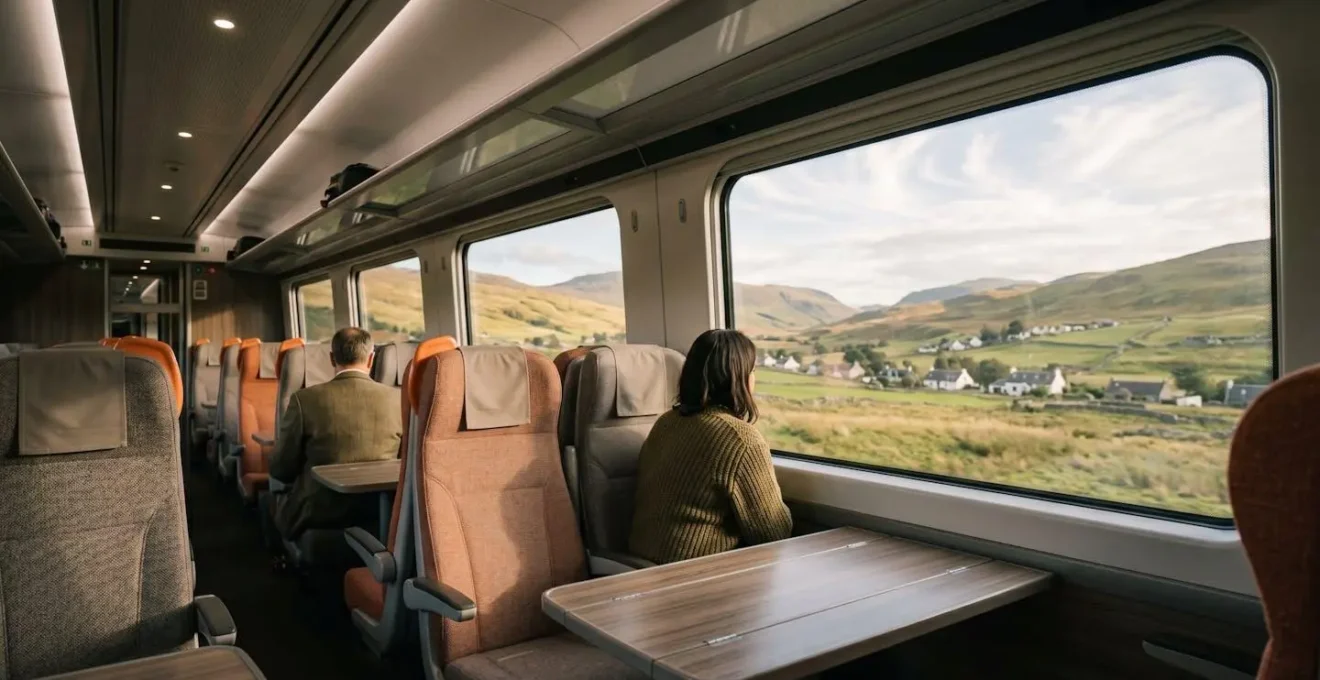
Choosing the train over a cheap flight isn’t a sacrifice; it’s a strategic upgrade to your entire holiday experience.
- The true environmental impact of flying is up to 13 times higher than the train, even before considering non-CO2 effects.
- Value is more than the ticket price; it includes avoiding airport stress, arriving in city centres, and the quality of the journey itself.
Recommendation: Reframe your decision from a simple cost comparison to a “total experience value” analysis, factoring in carbon, convenience, and comfort.
For any UK traveller planning a European getaway, the moment of truth arrives on the booking screen. On one side, a £50 return flight to a sun-drenched city, almost too good to be true. On the other, a Eurostar ticket that can easily cost three or four times as much. The logical, budget-conscious part of our brain screams to click “book” on the flight. It seems obvious, a solved equation where cost is king.
For years, the conversation has been framed by two simple, competing truths: flying is cheap and fast, while training is expensive but green. This binary view, however, misses the bigger picture entirely. It ignores the hidden “costs” of that cheap flight—the pre-dawn taxi to a remote airport, the queues, the security theatre, the environmental toll that goes far beyond just CO2, and the frazzled arrival in a city’s outskirts. It also fails to quantify the profound “value” of the alternative.
But what if the entire framework is wrong? What if the real value of a holiday isn’t found in the lowest ticket price, but in the total quality of the experience? This analysis moves beyond the simplistic cost-per-mile calculation. We will deconstruct the true value of European train travel by examining the nuanced carbon footprint, the pitfalls of travel industry “greenwashing,” the critical packing strategies that make or break a journey, and the post-Brexit rules that can derail a long summer holiday.
This guide will explore the real cost-benefit analysis of flight-free travel, providing the tools to make an informed choice that aligns not just with your wallet, but with the kind of travel experience you truly want. Below is a detailed breakdown of the key considerations that shift the balance in favour of the rails.
Summary: The True Value of European Train Travel: A Comprehensive Analysis
- Why Flying to Edinburgh Emits 5x More CO2 Than Taking the Train?
- How to Spot Greenwashing in Hotel Sustainability Claims?
- Staycation in Cornwall or Train to Provence: Which Is Truly Greener?
- The Packing Mistake That Makes Train Travel a Nightmare
- When to Book Eurostar Tickets to Secure the Lowest Fares?
- Why Your 90-Day Allowance Doesn’t Reset on January 1st?
- How to Explore Windermere and Ambleside Entirely by Bus and Boat?
- How the 90/180 Day Rule Ruins Your Long European Summer?
Why Flying to Edinburgh Emits 5x More CO2 Than Taking the Train?
The most immediate and quantifiable argument for train travel is its environmental benefit, but the headline figures often understate the reality. While the title suggests a fivefold difference, a detailed analysis reveals an even more dramatic disparity. For a journey from London to Edinburgh, taking the train generates approximately 12.5kg of CO2 equivalent per passenger. The same journey by plane? A staggering 165kg. That isn’t a 5x difference; it’s a 13x greater carbon footprint for the flight, according to the Green Travel Pledge carbon calculator developed by Thrust Carbon.
This massive gap is due to the fundamental inefficiency of lifting a heavy metal tube miles into the sky. But even this figure doesn’t tell the whole story. The direct CO2 emissions are only part of aviation’s climate impact. As Greenpeace UK points out, the equation is far more complex.
The overall climate impact of flying can be over 80 times worse than taking a train if we include the non-CO2 impacts of air travel (such as NOx and water vapours).
– Greenpeace UK, Greenpeace UK report on train vs. air travel emissions
These non-CO2 effects, which include the release of nitrogen oxides (NOx) and the formation of long-lasting condensation trails (contrails) at high altitudes, create a “radiative forcing” effect that traps even more heat in the atmosphere. When you factor in these elements, the “value” of a cheap flight ticket begins to look ethically expensive. Choosing the train isn’t just a marginal gain; it’s a fundamentally different choice in terms of climate responsibility, representing the first and most significant pillar of its superior value proposition.
How to Spot Greenwashing in Hotel Sustainability Claims?
Once you’ve made the greener choice to travel by train, the journey towards a sustainable holiday is only half complete. The accommodation sector is rife with “greenwashing”—vague or misleading claims of environmental friendliness designed to attract conscious travellers without substantive action. A hotel boasting it’s “eco-friendly” because it encourages guests to reuse towels is a classic example. This is a cost-saving measure masquerading as a green initiative. To truly assess the value of a hotel’s sustainability promise, you need to look for concrete evidence and third-party validation.
The desire for authentic green credentials is not a niche concern. Research shows a significant majority of global travelers, up to 83%, state that sustainable travel is important to them. Furthermore, 45% of these travellers find accommodations more appealing when they hold a credible sustainability certification. This proves that travellers are actively looking for reliable signals of genuine commitment. The key is to differentiate between marketing fluff and measurable action. A truly sustainable property will be transparent about its practices, reporting on metrics like energy and water consumption, waste management, and local sourcing.
Instead of falling for vague language, you can become an informed traveller by actively auditing a hotel’s claims. This means looking for recognized, independently-audited certifications which prove a property has met rigorous standards. This critical approach ensures your spending supports businesses that are genuinely contributing to a more sustainable tourism model, rather than those simply capitalizing on a trend.
Your Action Plan: Vetting Hotel Sustainability
- Points of contact: Look for third-party certifications on the hotel’s website and booking platforms (e.g., Green Key, EarthCheck, B Corp, EU Ecolabel).
- Collecte: Inventory their claims. Are they vague (“eco-friendly”) or specific (“100% of our energy is from renewable sources,” with data to back it up)?
- Cohérence: Check if the hotel publishes a public sustainability report with measurable data and transparent targets. Does this align with their marketing?
- Mémorabilité/émotion: Does the commitment feel deep and integrated, or like a last-minute marketing plaster? Look for staff knowledge and community involvement.
- Plan d’intégration: Prioritize booking with certified properties. Use filters on booking sites to find them easily near your central train station arrival point.
Staycation in Cornwall or Train to Provence: Which Is Truly Greener?
The sustainable travel debate often presents a false dichotomy: the virtuous, low-impact “staycation” versus the indulgent, high-impact international trip. However, this simplistic view crumbles under scrutiny. The question is not merely *where* you go, but *how* you travel, both to your destination and during your stay. A long-distance train journey to the South of France might, counter-intuitively, have a smaller overall carbon footprint than a week-long holiday in Cornwall if the latter involves extensive driving.
This introduces the critical concept of “last-mile” emissions. The main journey is only one part of the equation. As an analysis of travel footprints shows, the real environmental cost is often hidden in how we move around once we’ve “arrived.” A train to Avignon delivers you to the heart of Provence with minimal emissions. But if you then rent a car and spend a week driving hundreds of kilometres between charming hilltop villages, your total footprint can escalate rapidly. Research highlights that driving a medium car for 500km can produce 85kg of CO2eq. Multiple such trips can easily eclipse the emissions saved by not flying.
Conversely, a staycation in Cornwall might seem inherently low-impact. Yet, if it involves a long drive from London and then daily car journeys from a central base to scattered beaches and attractions, the emissions add up. The truly “greener” option is the one that minimizes reliance on private cars for the entire duration of the trip. This requires a more holistic assessment, weighing the efficiency of the primary mode of transport against the sustainability of local mobility. Often, the better value lies in choosing a destination with a robust public transport network that you can leverage upon arrival, whether that’s in Provence or the Peak District.
The Packing Mistake That Makes Train Travel a Nightmare
One of the great, romanticised benefits of train travel is the generous luggage allowance. No tiny liquid bottles, no paying extra for a suitcase. You can, in theory, bring whatever you want. This freedom, however, is a trap for the unwary. The single biggest mistake that turns a serene rail journey into a logistical nightmare is overpacking or packing improperly. Hauling a heavy, oversized hard-shell suitcase through a crowded station, struggling to lift it onto a high overhead rack, and blocking an entire aisle while you search for a book is the antithesis of the elegant, stress-free experience the train promises.
The value of the train journey is directly linked to its seamlessness. To preserve this, you must adopt a strategic packing system. The key is to think of your luggage not as one entity, but as two: the main bag and the go-bag. This “at-seat” system is the secret to a fluid and comfortable journey. By separating what you need for the journey from what you need for the destination, you eliminate the primary source of onboard friction and retain your mobility and peace of mind.
Mastering this simple system transforms your relationship with your luggage from adversarial to symbiotic. Your journey remains fluid, your stress levels low, and your enjoyment high. Here are the key principles for a seamless train travel packing strategy:
- The Main Bag: Pack a larger, preferably soft-shell suitcase with items you won’t need during the journey. This goes on the overhead rack or in the designated luggage area at the end of the carriage and is not touched until you arrive.
- The Go-Bag: This is a dedicated smaller bag (tote or backpack) that stays with you at your seat. It contains all journey essentials: passport, tickets, phone, charger, a book or tablet, a water bottle, and snacks.
- Wheels Matter: Opt for 2-wheeled luggage over 4-wheel “spinner” cases. They are more stable on uneven train platforms and easier to pull through narrow train aisles.
- Soft is Better: Avoid rigid, hard-shell cases if possible. Soft-shell bags have more give, making them easier to squeeze into tight or oddly-shaped luggage spaces on trains.
When to Book Eurostar Tickets to Secure the Lowest Fares?
While this analysis champions the “value beyond cost” of train travel, the initial price remains a significant factor for any UK holidaymaker. Fortunately, securing the lowest Eurostar fares isn’t a dark art; it’s a science based on timing. The single most important rule is to book as early as possible. Eurostar’s pricing structure is dynamic, meaning prices rise steadily as the departure date approaches and seat availability decreases. The cheapest tickets are always the first ones sold.
Generally, Eurostar releases tickets for booking in blocks, typically up to 120 days (around 4 months) in advance for most direct routes from London to Paris, Brussels, and Amsterdam. For connecting journeys further into Europe (e.g., to Germany or the South of France), this window can be even larger, sometimes opening 6 to 8 months ahead. By setting a calendar reminder and booking the day tickets are released, you can often secure fares that are dramatically cheaper than those available a month or two before travel, making the price difference with flying much less pronounced.
Once you’ve decided to book, you’re faced with another choice: the fare class. This is where the “total experience value” comes back into play. A Standard class ticket offers fantastic value if your priority is simply the A-to-B journey. However, for a small premium, Eurostar Plus can offer a significant upgrade in comfort, while Premier is a full-service business class experience. Understanding the cost-benefit of each is key, as shown in a recent fare analysis.
| Fare Class | Starting Price | Included Amenities | Value Assessment |
|---|---|---|---|
| Eurostar Standard | From £39 / €44 | 2 luggage pieces, 1 carry-on, no meal | Best for budget travelers; purchase food separately |
| Eurostar Plus | From £119 / €119 | Spacious seating, light meal, drinks, newspapers, power outlets | Premium ~£80 over Standard; meal value ~£15-20, worth it for comfort seekers |
| Eurostar Premier | From £310 / €310 | Lounge access, hot meals by Raymond Blanc, champagne, fast-track, 3 luggage pieces | High premium for business travelers; includes services worth ~£100-150 |
Why Your 90-Day Allowance Doesn’t Reset on January 1st?
For British travellers planning a long European summer, the most significant post-Brexit travel constraint is the Schengen Area’s 90/180 day rule. A common and dangerous misconception is that this 90-day allowance is a simple block of time that resets on a fixed date, like the start of a new year. This is incorrect. The rule operates on a “rolling” 180-day window, a concept that is crucial to understand to avoid overstaying and facing potential fines or entry bans.
Think of it like a continuous tape measure extending 180 days into the past from today. At any given moment, you must not have been present in the Schengen Area for more than 90 days within that backward-looking 180-day period. This means every day you spend in the zone, you use up a day. Every day you spend outside the zone, a day from 181 days ago “falls off” the back of the rolling window, potentially freeing up a day for future use. It is a constant, fluid calculation, not a static allowance.
This “rolling” nature is what trips up many travellers. A three-month trip from June 1st to August 30th (approximately 90 days) means you cannot re-enter the Schengen zone for another 90 days. Your ability to return isn’t reset on January 1st; it’s determined by your specific, personal travel history. The value of a carefully planned itinerary is immense, but that value is completely negated if you miscalculate your days and are forced to cut your trip short or face legal consequences. Diligently tracking your entry and exit dates is no longer optional; it’s a fundamental part of modern European travel for UK citizens.
How to Explore Windermere and Ambleside Entirely by Bus and Boat?
The principle of sustainable, car-free travel doesn’t just apply to grand European tours; it finds its perfect expression in quintessentially British landscapes like the Lake District. Arriving by train to Windermere station is the first step in immersing yourself in a slower, more observant mode of travel. The real magic begins when you realise the entire central lakes area, including the bustling hubs of Windermere and Ambleside, can be explored beautifully and efficiently without ever getting behind the wheel of a car.
The key is to embrace the local transport network as part of the experience. The Stagecoach 599 bus is the spine of this network, an open-top double-decker in the summer months that traces the shoreline of Lake Windermere. The journey from Windermere town down to Bowness-on-Windermere, and then continuing along the lake to Ambleside, isn’t just transport; it’s a sightseeing tour. Sitting on the top deck, you gain a vantage point over dry stone walls and hedgerows, with panoramic views of the lake and surrounding fells.
From the piers at Bowness or Ambleside, the journey continues on the water. Windermere Lake Cruises operate a fleet of steamers and modern launches that criss-cross the lake, connecting key points and offering a perspective of the landscape that is impossible to get from the road. A “Freedom of the Lake” ticket allows you to hop on and off at will, combining a boat trip with a walk. You can, for example, take a boat from Ambleside to the Wray Castle jetty, explore the mock-gothic castle, and then walk a portion of the serene western shoreline path. This synergy of bus and boat transforms transit time into a core part of the holiday’s pleasure and value.
Key takeaways
- The true carbon cost of flying is drastically understated; the total climate impact can be over 80 times worse than train travel.
- “Value” in travel extends beyond the ticket price to include logistical ease, mental well-being, and arriving centrally and refreshed.
- Strategic planning is essential: booking train tickets early, packing efficiently, and understanding visa rules are key to unlocking the train’s superior value.
How the 90/180 Day Rule Ruins Your Long European Summer?
For the UK traveller dreaming of a long, meandering summer through Europe, the 90/180 day rule is the single greatest threat to that vision. It acts as a hard ceiling on freedom, capable of abruptly ending a trip and turning a dream holiday into a bureaucratic nightmare. The Schengen Area, a zone of border-free travel, now acts as a giant, unified territory for immigration purposes. The Schengen Area comprises 29 countries, and your 90-day limit is for the entire bloc, not per country. Once you’ve used your 90 days, you are barred from all of them until your rolling 180-day window frees up more time.
This fundamentally alters the calculus of long-term travel. A spontaneous, go-where-the-wind-takes-you approach is now fraught with risk. The value of your trip is intrinsically tied to your ability to navigate this rule successfully. An itinerary that doesn’t account for the “Schengen clock” is a flawed itinerary. However, all is not lost. For the strategic traveller, the rule is not an insurmountable wall but a puzzle to be solved. By intelligently integrating non-Schengen countries into your itinerary, you can effectively “pause” the clock and extend your time in Europe significantly.
This strategic itinerary design is the new frontier of slow travel for Brits. It requires more planning, but it’s what makes a 4, 5, or 6-month European adventure still possible. Here are some proven concepts for pausing the Schengen clock, all accessible by train:
- The Balkan Bounce: Use non-Schengen countries in the Balkans like Albania, Bosnia and Herzegovina, Serbia, or North Macedonia to take a break. Train routes from Vienna to Zagreb or Budapest to Belgrade can be your gateway.
- The UK/Ireland Interlude: Returning to the UK or visiting Ireland (which has its own rules as part of the Common Travel Area) effectively stops the clock and allows your 180-day window to shift.
- The Turkey Extension: Turkey is a vast, culturally rich non-Schengen country easily accessible by train from Schengen members Greece or Bulgaria, offering a perfect place for an extended stay.
- Plan for Buffers: Always build buffer days into your plan and carry meticulous documentation of your entry and exit dates, especially for land borders where stamping can be less consistent.
Armed with this comprehensive understanding, you can now move beyond the deceptive simplicity of a cheap flight’s price tag. The next step is to begin mapping out your own journey, calculating not just the financial cost, but the true, holistic value of your next European adventure.