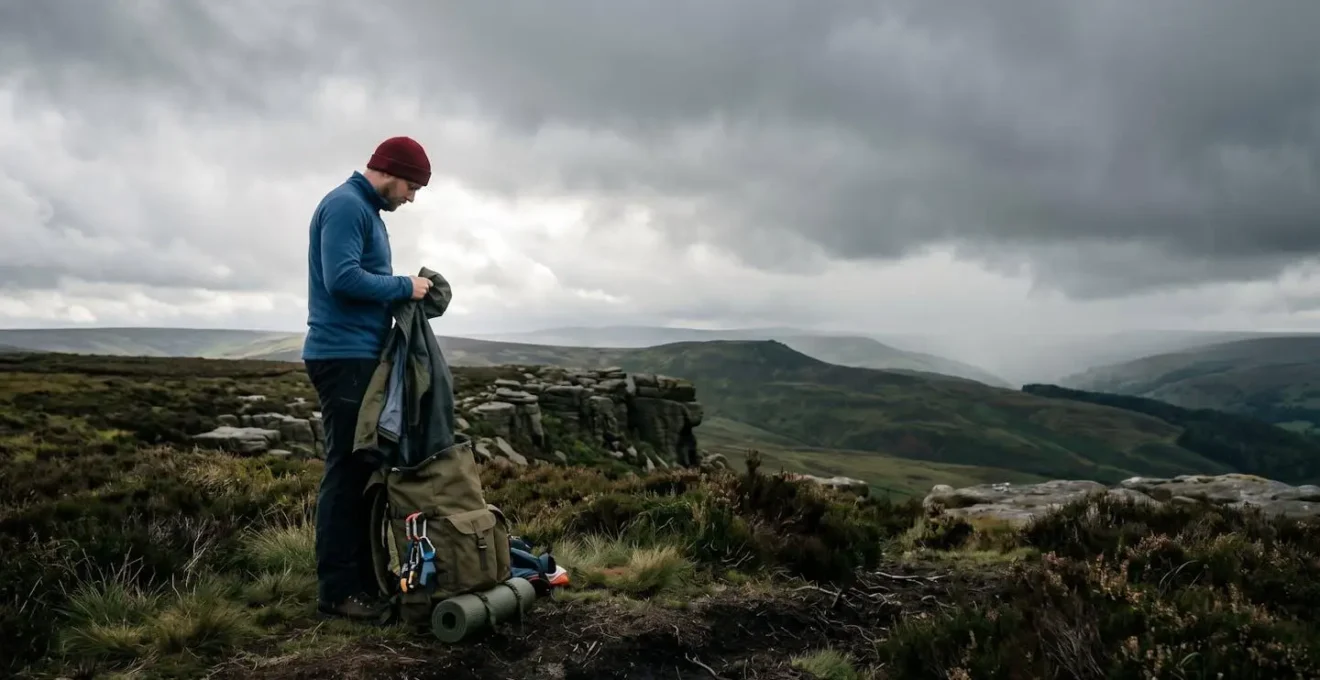
Facing a rainy Peak District hike isn’t about hoping you stay dry; it’s about building a robust safety system for when your gear and plans fail. This guide moves beyond generic advice, focusing on understanding failure points—from cheap waterproofs ‘wetting out’ to GPS batteries dying in the cold. By establishing pre-agreed decision triggers and mastering a few critical skills, you can turn a potentially dangerous day into a challenging but safe and rewarding adventure.
The beauty of the Peak District is deceptive. One minute, sunlight illuminates the purple heather of the moors; the next, a wall of grey cloud sweeps over Kinder Scout, and the temperature plummets. For the amateur hiker, the forecast of rain isn’t just a spoiler; it’s a source of genuine anxiety about getting soaked, lost, or worse. The internet is full of well-meaning but shallow advice: “buy waterproofs,” “check the weather,” “take a map.” This advice is not wrong, but it is dangerously incomplete.
It fails to address the critical questions that arise when you are actually on the hill, visibility has dropped to 20 metres, and the rain is driving horizontally into your face. What happens when your “waterproof” jacket stops working? How do you use a map when your hands are numb and the wind is trying to rip it from your grasp? The conventional approach focuses on preventing problems, but it doesn’t prepare you for managing them when they inevitably occur. True safety isn’t found in a perfect forecast or expensive gear alone.
The real key to safely and enjoyably hiking in the Peak District is to shift your mindset from avoiding failure to building a resilient system that anticipates it. This guide is built on that principle. We will deconstruct the common failure points—in gear, navigation, nutrition, and decision-making—and provide you with the knowledge to build a personal safety protocol. We will explore why cheap gear fails, how to navigate when technology dies, and the psychological mechanisms that ensure you make smart choices under pressure. The goal is not just to survive a rainy day, but to gain the confidence to embrace it.
This article will provide a structured system for your preparation. Each section addresses a critical component of your safety, moving from equipment and navigation to the crucial psychological aspects of mountain-craft, ensuring you have a comprehensive plan before you even lace up your boots.
Summary: A System for Hiking the Peak District in the Rain
- Why Buying Cheap Rain Gear Will Ruin Your Hike in 30 Minutes?
- How to Read an OS Map When Your GPS Fails on the Moors?
- Circular Walk or Ridge Scramble: Which Is Safe for Beginners?
- The Mistake With Cows That Injures Dog Walkers Every Year
- How to Pack a Lunch That Keeps You Energized for 6 Hours?
- The Reserve Parachute Mechanism That Guarantees Safety
- The Footpath Erosion Caused by Tourists Taking Shortcuts
- Why Controlled Fear in Sports Resets Your Dopamine Levels?
Why Buying Cheap Rain Gear Will Ruin Your Hike in 30 Minutes?
The most common failure point for inexperienced hikers is trusting a “water-resistant” or cheap “waterproof” jacket in sustained Peak District rain. The problem isn’t just a few drips getting through; it’s a catastrophic system failure known as ‘wetting out’. This occurs when the outer fabric becomes so saturated with water that it blocks the breathable membrane from releasing your sweat. Within minutes, you are soaking wet from the inside, your body temperature plummets, and the jacket becomes a cold, heavy liability. This is how the first stage of hypothermia begins.
To be legally sold as waterproof in the UK, a fabric only needs to withstand a minimal amount of water pressure. While the British standard for waterproof jackets requires a 1,500mm minimum hydrostatic head rating, this is woefully inadequate for the conditions you’ll face. For hiking on exposed ridges like Stanage Edge, where rain is driven horizontally by the wind, a rating of 10,000mm or higher is essential for your gear system to function. This ensures the outer layer can resist the pressure of wind-driven rain and the weight of a rucksack strap, preventing the ‘wetting out’ cascade.
As you can see in the technical fabric detail, a properly functioning Durable Water Repellent (DWR) coating causes water to bead up and roll off the surface. When this coating wears off on cheaper garments or isn’t reapplied, the fabric saturates. Investing in a quality hardshell jacket with taped seams and a high hydrostatic head rating isn’t a luxury; it’s the fundamental component of your weather-protection system, the one that prevents a simple rain shower from becoming a genuine emergency.
Ultimately, your outer layer is your first line of defence. Treating it as an afterthought is the first and most critical mistake you can make. It is the barrier that keeps your core warm and your mind focused on navigation and safety, rather than just surviving the cold.
How to Read an OS Map When Your GPS Fails on the Moors?
Over-reliance on GPS devices and smartphone apps is the modern hiker’s Achilles’ heel. While convenient, they create a dangerous illusion of security. The entire system is fragile, susceptible to a single point of failure: the battery. In the cold, wet conditions of the Peak District, this failure is not a remote possibility, but a predictable certainty. Indeed, studies of GPS usage in cold weather show a 15-20% battery drain per hour or more, meaning a fully charged phone can be useless in the time it takes to walk from Edale to Kinder Downfall. When the screen goes blank in thick mist, you are not just lost; you are stripped of your primary decision-making tool.
This is why mastering the use of a physical OS map and compass is not an old-fashioned skill; it is a non-negotiable part of your safety system. It is your backup generator, your manual override. In poor visibility, the map provides the crucial context your GPS cannot: the shape of the land around you. Key techniques become vital:
- Handrailing: Following a linear feature like a stone wall, a stream, or a fence line. On the featureless plateau of Kinder Scout, deliberately navigating to a known stream and following it is infinitely safer than trying to walk on a compass bearing across treacherous, boggy ground.
- Catching Features: Identifying a large, unmissable feature on your map that lies beyond your target, like a main road or a reservoir. If you reach this feature, you know you have gone too far and can correct your course.
- Pacing and Timing: Knowing how many double-paces it takes you to cover 100 metres. In thick fog, this allows you to measure distance travelled from a known point, helping you pinpoint your location with surprising accuracy.
Your Pre-Hike Navigation Audit:
- Points of contact: Can you identify 5 major features on your map (peaks, valleys, streams, walls, roads)?
- Collecte: Do you have a physical map (in a waterproof case) and a compass you know how to use?
- Cohérence: Have you practiced taking a bearing in your garden, not just in theory?
- Mémorabilité/émotion: Can you orient the map to the ground without thinking, even with gloves on?
- Plan d’intégration: Have you identified your ‘handrail’ features and ‘catching features’ for each leg of the journey before you leave?
A dead GPS is a moment of inconvenience for a prepared hiker. For the unprepared, it is the start of a potential disaster. The difference is determined by the skills you practiced in the warm and dry, long before you needed them in the cold and wet.
Circular Walk or Ridge Scramble: Which Is Safe for Beginners?
Choosing the right route is the most important safety decision you will make, and it must be made before you leave the house. A common mistake for beginners, lured by dramatic photos, is to commit to a Grade 1 scramble or an exposed ridge walk like the one over Mam Tor, without considering how rain and wind will transform it. In wet conditions, a fun scramble can become a treacherous, slippery climb with serious consequences, while a sheltered valley walk remains a pleasant day out. A Mountain Rescue England and Wales 2024 review revealed that a majority of callouts resulted from human errors linked to inexperience and weather, often a simple case of being in the wrong place at the wrong time.
The key is to understand how the local environment reacts to weather—a concept of reading the ‘environmental feedback’. The Peak District offers a perfect lesson in this. Its geology is split into two distinct types: the Dark Peak, with its dark, acidic peat and coarse gritstone edges (like Stanage or the Roaches), and the White Peak, with its lush green dales and pale limestone rock (like Dovedale). When wet, gritstone retains a remarkable amount of grip, making it relatively secure underfoot. Limestone, however, becomes notoriously slick and treacherous, like walking on wet glass. A route choice that is safe in the Dark Peak might be reckless in the White Peak under the exact same weather conditions.
This is where your planning must include pre-defined ‘decision triggers’. Your Plan A might be the glorious ridge walk. But you must also have a Plan B—a lower-level, more sheltered alternative. The trigger to switch plans should be objective and non-negotiable, decided in the comfort of your home, not debated on a windy col. Examples of triggers include:
- If wind speed exceeds 30 mph on the summit forecast.
- If visibility drops below the length of a football pitch (100m).
- If the scramble you are approaching looks dark and slick with running water.
The safe choice is not always the easiest or shortest; it is the one that is most appropriate for the conditions on the day and for the least experienced person in your group. Having the humility to take the ‘boring’ valley path is a sign of an experienced mountaineer, not a novice.
The Mistake With Cows That Injures Dog Walkers Every Year
Of all the objective dangers in the Peak District, from steep drops to sudden floods, one of the most consistently underestimated is livestock. Specifically, encounters with cattle are a significant cause of serious injury and even death for walkers, and the risk is amplified enormously by two factors: rain and dogs. In poor weather, cattle often shelter in dense groups in locations that might block a footpath, leading to surprise encounters in low visibility. The reaction of the herd to you and your dog is not something you can afford to misjudge.
The statistics are sobering. A review of incidents by the Health and Safety Executive shows that between 2019 and 2023, 22 people were killed by cows in the UK, and the overwhelming majority of these incidents involved a dog. Cows, especially with calves, perceive a dog not as a pet, but as a predator, like a wolf. Their defensive-aggressive response is instinctual. The single most critical mistake a dog walker can make is to hold onto their dog if a cow charges. As researchers from the University of Liverpool noted in their study on cattle attacks, the data is starkly clear. They state:
94% of walkers killed had dogs, and two thirds of all attacks involved dogs.
– Dr Carri Westgarth and K. Marie McIntyre, University of Liverpool cattle attack research
Your safety protocol must be clear and rehearsed. If you feel threatened and cattle start to move towards you aggressively:
- Let the dog go. Drop the lead immediately. The dog is much faster and more agile than you and can escape. The cows will likely focus on the dog, the perceived threat, allowing you to move away calmly.
- Do not run. This can trigger a chase instinct. Back away slowly, keeping an eye on the animals but without making direct eye contact.
- Never get between a cow and its calf. Be especially vigilant during spring calving season and give any group with young animals an extremely wide berth.
Understanding this animal behaviour is as crucial as understanding the weather. It is another piece of ‘environmental feedback’ that you must learn to read and react to correctly. Your attachment to your dog’s lead should never be stronger than your instinct for survival.
How to Pack a Lunch That Keeps You Energized for 6 Hours?
In cold, wet, and windy conditions, your body is in a constant battle to stay warm—a process called thermogenesis. This burns a huge number of calories. A 5°C day on an exposed ridge can feel like -2°C with wind chill, dramatically increasing your energy demands. The classic summer hiking lunch of a salad sandwich and a piece of fruit is dangerously insufficient. It leads to a state of ‘calorie debt’, where your body doesn’t have the fuel to generate heat or power your muscles. The consequences are not just feeling cold and tired; your cognitive function plummets. You start making poor decisions, you lose motivation, and you become more susceptible to accidents and hypothermia.
Your food for a rainy Peak District hike must be treated as a critical part of your heating and morale system. Forget about your normal diet; this is about survival fuel. You need calorie-dense, high-fat foods that provide slow-release energy. Think of the traditional foods of hill-goers: pork pies, flapjacks, cheese, nuts, and Kendal Mint Cake. These are not just treats; they are performance-enhancing tools. A warm drink from a flask is also non-negotiable. It does more than just warm you up; it provides a profound psychological reset, a moment of comfort and normality that can completely reverse declining morale and sharpen your decision-making.
Equally important is *how* you pack and eat. A long, exposed lunch break is a recipe for getting dangerously cold. The goal is to refuel on the move with minimal heat loss. Your food strategy should be:
- Pre-cut and accessible: All food should be cut into bite-sized portions before you leave. Snacks must be in small, easy-to-open bags stored in your jacket or trouser pockets, not buried at the bottom of your rucksack.
- Glove-friendly: Choose foods you can eat without taking your gloves off. Cereal bars, dried fruit, and sweets like Jelly Babies are perfect.
- Frequent refuelling: Adopt the mindset of “a little and often.” Graze throughout the day to maintain a steady energy level, rather than relying on one big meal.
In the challenging environment of the moors in winter, a hot cup of soup and a flapjack are not a luxury; they are as vital a piece of safety equipment as your compass.
Key takeaways
- True safety lies in building a resilient system that anticipates failure, not just avoiding rain.
- Mastering map and compass is a non-negotiable backup for predictable GPS failure in cold conditions.
- Your plan must include objective ‘decision triggers’ for switching to a safer, pre-planned alternative route.
The Reserve Parachute Mechanism That Guarantees Safety
The most dangerous mindset in the mountains is ‘summit fever’—the irrational desire to reach a goal, even when all objective signs indicate you should turn back. When you are cold, tired, and slightly disoriented, your judgement is impaired. You will be tempted to push on, to ignore the worsening weather, to take a ‘small’ risk. This is where you need a ‘Reserve Parachute’: a pre-agreed, emotion-free protocol that makes the decision for you.
This is not just a figure of speech; it’s an algorithmic approach to safety created in the warm and dry to combat the flawed logic of a cold and wet brain. The mechanism has two parts: a set of objective trigger conditions and a physical kit. The triggers are a pact you make with yourself and your group before you set off. The rule is simple: if any single trigger condition is met, the entire group turns back or deploys their emergency plan immediately. There is no debate, no persuasion, no discussion of “just another 10 minutes.”
Examples of effective trigger conditions include:
- Visibility: “If we cannot clearly see the person 20 metres ahead of us, we turn back.”
- Cold: “If any person in the group reports feeling uncontrollably cold or starts shivering violently, we stop and use the emergency shelter.”
- Wind: “If the wind is strong enough to make us stumble or lose our balance, we descend to a lower elevation immediately.”
- Group consensus: “Any single member of the group can call for a retreat at any time, for any reason, and their decision will be respected without question.”
The second part is the physical parachute: a small, dedicated dry-bag that never leaves your rucksack. This should contain a fully charged power bank for your phone, a bothy bag or survival shelter (a simple plastic tent that traps body heat), a high-energy emergency gel or food bar, a whistle, and chemical hand warmers. It is a lifeline that allows you to get out of the wind and rain, warm up, and make a clear-headed plan.
Deploying your bothy bag on a misty moor might feel like a failure to complete your planned route. It is not. It is the successful execution of your safety plan. It is a sign of experience and good judgement, the very definition of competent mountain-craft.
The Footpath Erosion Caused by Tourists Taking Shortcuts
When a popular Peak District path becomes a muddy trench after days of rain, the natural instinct is to walk on the grassy verge to keep your boots clean. This seemingly harmless decision, when repeated by thousands of walkers, has a devastating impact. It widens the path, kills the vegetation, and leads to massive soil erosion, scarring the landscape. But beyond the environmental damage, taking these shortcuts is a critical safety error. It is a misreading of ‘environmental feedback’ that can lead you into danger.
The engineered stone paths you see on major routes are there for a reason: they provide a stable, durable surface on otherwise treacherous ground. The saturated, unstable peat and soil on the path edges is far more likely to cause a slip or a twisted ankle than the muddy stones of the path itself. More dangerously, this habit of leaving the main trail can lead you into one of the Peak District’s most hidden hazards: peat ‘groughs’. These are deep, often concealed, erosion channels that snake across the plateaus. In mist or rain, stepping off the path to avoid a puddle could mean stepping directly into a grough, leading to a serious fall and injury.
Furthermore, these shortcuts create misleading ‘social trails’. These are unofficial paths worn into the ground by the passage of many feet, but they follow no logical route. A lost walker might wander off the main path, and over time, their footsteps create a new trail that looks like a legitimate path. The next lost group follows it, reinforcing the false trail. This creates a dangerous feedback loop where erosion patterns created by previous navigational errors lure future hikers further into danger. The rule must be to trust your map and compass, not the worn ground. A line on the grass may simply be a scar, not a path.
Staying on the path, even when it’s muddy and unpleasant, is therefore not just an act of environmental responsibility. It is a fundamental discipline of safe navigation, ensuring you are following a route designed for passage, not an accidental scar leading nowhere.
Why Controlled Fear in Sports Resets Your Dopamine Levels?
After outlining the potential for gear failure, navigational errors, and environmental hazards, it would be easy to conclude that hiking in the Peak District rain is an activity to be avoided. But this would miss the entire point. The aim is not to eliminate fear, but to manage it. Facing a challenging environment and overcoming it with skill, preparation, and a robust safety system is one of the most rewarding experiences you can have. It is this process of managing ‘controlled fear’ that builds true self-reliance and profound satisfaction.
When you successfully navigate through thick mist using only your compass, or when you stay warm and comfortable in a downpour because your gear system worked perfectly, the feeling is not one of relief, but of accomplishment. You have not been a passive victim of the weather; you have been an active participant, making good decisions and proving your competence. This is the essence of adventure. As some experts say, hiking in the rain can become a fun and refreshing experience, but only when you have earned the right to enjoy it through diligent preparation.
The journey from being an anxious amateur worried about the rain to a confident hiker who sees it as just another variable is the real goal. Every challenge met—from choosing the right path to successfully avoiding a herd of cows—is a small victory. The dopamine reset mentioned in the title isn’t about a cheap thrill; it is the deep, lasting satisfaction that comes from proving to yourself that you are capable, resilient, and in control, even when the world around you is wild and unpredictable.
Your goal should be to assemble this system of gear, skills, and decision-making protocols. Once it is in place, you will find that a forecast for rain is no longer a reason to cancel your plans, but an invitation to a true Peak District adventure.