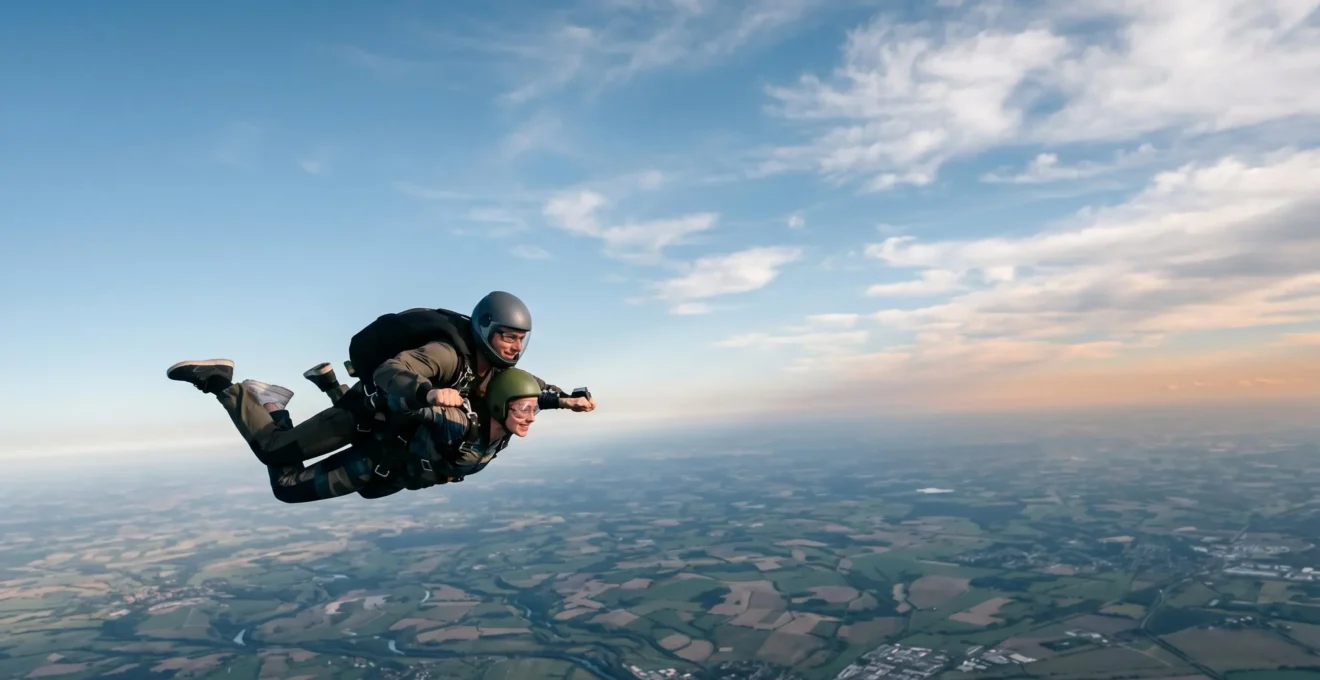
The intense fear of heights you feel on a ladder or balcony does not translate to a skydive because your brain lacks the physical references to process the altitude as a threat.
- Physiologically, the absence of a “stomach drop” sensation is due to exiting a plane already at speed and the brain’s inability to perceive depth from such a great height.
- Technologically, multiple layers of safety, including a mandatory automatic activation device (AAD), provide an engineered guarantee that a parachute will open.
Recommendation: Shift your focus from the fear itself to understanding the specific mechanics and safety procedures that are designed to manage and mitigate that fear for you.
The very idea of willingly jumping from a plane can seem like a direct confrontation with acrophobia, a fear that grips you on a high balcony or a steep cliff edge. Many believe that the terror they feel in those situations will simply be amplified a thousand times over at 15,000 feet. The common advice—”just don’t look down,” “you’ll be fine”—often feels dismissive, failing to address the very real, physical sensations of fear.
This guide takes a different approach. As a skydiving instructor, I know that reassurance alone isn’t enough. True confidence comes from understanding. Instead of just telling you it’s safe, I’m going to explain *why* it’s safe from a technical, physical, and psychological standpoint. We will explore why the sensations you dread, like the stomach-lurching drop, are absent from the experience. We’ll delve into the engineered redundancies that make the equipment exceptionally reliable.
The key isn’t to ignore your fear, but to dismantle it with knowledge. By understanding the science that governs freefall and the robust procedures that protect you, you can reframe the experience. It ceases to be a leap into the unknown and becomes a calculated, controlled activity. This article will walk you through the mechanics of the jump, the safety systems in place, and the mental strategies that turn potential panic into an unparalleled state of flow, empowering you to make an informed decision about taking on this incredible challenge.
Summary: Is Tandem Skydiving Safe If You Have a Fear of Heights?
- Why You Don’t Get that ‘Stomach Drop’ Feeling When Skydiving?
- How to Check if Your Asthma Prevents You From Skydiving?
- 7,000ft or 15,000ft: Is the Extra Height Worth the Extra Cost?
- The Reserve Parachute Mechanism That Guarantees Safety
- When to Book Your Jump to Avoid UK Weather Cancellations?
- Flow State vs Panic: How to Find the Sweet Spot in Extreme Sports?
- Mountain Leader or Rock Climbing Instructor: Which Qualification First?
- How to Become a Certified Outdoor Instructor in the UK Under £2k?
Why You Don’t Get that ‘Stomach Drop’ Feeling When Skydiving?
The single most anticipated—and feared—sensation is that stomach-in-your-throat lurch you get on a roller coaster. But it doesn’t happen in skydiving. The reason is physics. A roller coaster drop is an acceleration from a near-standstill. When you exit an airplane, you are already moving forward at 80-100 mph. You don’t “drop”; you transition from forward motion to downward motion, carried on a cushion of air. You immediately hit terminal velocity (around 120 mph), so there is no feeling of ongoing acceleration.
The other crucial factor is the complete lack of visual reference. Your brain triggers vertigo when it sees the ground rushing up, creating a sense of rapid descent relative to a fixed object. At 13,000 feet, the ground looks like a flat, static map. Your brain has no reference points to process the speed or altitude. In fact, research shows that at altitude, our visual depth perception is limited to around 200 feet. Anything beyond that is an abstraction, which is why it feels more like floating than falling.
This sensory disconnect also applies to your vestibular system, the balance-sensing mechanism in your inner ear. Since you are not accelerating and have no visual cues of falling, your body’s internal systems report a state of floating or being supported by a strong wind. This combination of factors is the core reason why the fear of heights doesn’t manifest in the way you expect.
How to Check if Your Asthma Prevents You From Skydiving?
Having a medical condition like asthma naturally adds another layer of concern. However, as the Long Island Skydiving Center notes, “Yes, it’s entirely possible to skydive with asthma as long as it’s under control!” The key considerations are the cold air at altitude and the adrenaline-fueled excitement, both of which can be triggers for some individuals. A candid conversation with your doctor and the skydiving center is the most important first step.
Beyond asthma, general physical fitness is a factor. Most skydiving centers have a weight limit (often around 100-110 kg or 220-240 lbs) to ensure the equipment functions correctly and the instructor can safely manage the landing. Being transparent about any medical condition, not just asthma, is part of the shared responsibility for safety. Your instructor needs all the information to make the best decisions for your jump. For asthma specifically, following a clear pre-jump protocol is essential for your confidence and well-being.
Your Pre-Jump Asthma Action Plan
- Consult your physician: Obtain written medical clearance confirming your asthma is controlled and stable for this specific activity.
- Assess recent history: Ensure you haven’t had a significant asthma attack in recent months and do not require daily steroid medication.
- Identify triggers: Honestly evaluate if cold air or physical exertion commonly trigger your symptoms—both will be present during the skydive.
- Prepare your inhaler: Bring your reliever inhaler with you. Keep it in a secure, zipped pocket and inform your instructor where it is. If prescribed for exercise, use it 15-20 minutes before boarding.
- Communicate clearly: Inform your tandem instructor about your condition during the briefing. Establish a simple, non-verbal hand signal for any breathing difficulties during the jump.
Following these steps transforms your medical condition from an unknown variable into a managed part of the plan, reinforcing the procedural confidence that is central to a safe jump.
7,000ft or 15,000ft: Is the Extra Height Worth the Extra Cost?
At first glance, a lower altitude might seem less intimidating. A 7,000-foot jump is shorter, cheaper, and gets it “over with” faster. However, for someone with a fear of heights, the higher 15,000-foot jump is often the better choice, precisely because of the psychological experience it provides. The extended time in freefall is not more time to be scared; it’s more time for your brain to adapt and process what’s happening.
The difference lies in the “Fear Adaptation Window.” A short, 15-second freefall from 7,000 feet is often over before your brain can move past the initial sensory overload. In contrast, a 60-second freefall from 15,000 feet gives you time to progress from the initial shock, through the realization that you are not falling but floating, and into a state of exhilaration. This is where the cognitive reframing happens. The following table breaks down the key experiential differences.
| Altitude | Freefall Duration | Visual Ground Perception | Fear Adaptation Window | Plane Ride Anxiety |
|---|---|---|---|---|
| 7,000 ft | ~15 seconds | Ground more recognizable, depth cues partially visible | Minimal—over before brain adapts | Shorter, less anticipatory stress |
| 15,000 ft | ~60 seconds | Ground appears as abstract 2D map, zero depth perception | Extended—allows progression from shock to exhilaration | Longer, more anticipatory buildup |
Ultimately, the higher altitude provides a more profound experience of “altitude abstraction.” The ground is so far away that it loses its threatening quality, allowing you to fully immerse yourself in the sensation of flight. While the longer plane ride may increase anticipatory anxiety, the payoff during freefall is a much greater opportunity to conquer your fear, not just endure it.
The Reserve Parachute Mechanism That Guarantees Safety
Trust in skydiving isn’t just about trusting your instructor; it’s about trusting the system. Modern skydiving operates on a principle of engineered redundancy. You don’t have one parachute; you have three, in a sense. First is the main parachute, packed by a certified rigger and deployed by your instructor. If there is any issue with it, the procedure is to cut it away and immediately deploy the reserve parachute—a second, separately packed canopy.
But the ultimate safety net, and the one that should give the most comfort to an anxious mind, is the Automatic Activation Device (AAD). This is a small, incredibly precise computer that constantly measures your altitude and speed. If you are still falling at a high speed below a certain critical altitude (e.g., 750 feet), the AAD will automatically fire a small charge to deploy the reserve parachute for you. It acts independently of any human input. This device removes the possibility of human error in a critical situation.
The reliability of this technology is not theoretical. The AAD has an undeniable track record, with over 5,200 documented lives saved by the CYPRES system alone since its introduction. This isn’t just a backup; it’s a guarantee. It is the definitive technological answer to the question, “But what if…?” This system of primary, secondary, and automated backups is the foundation of modern skydiving safety.
When to Book Your Jump to Avoid UK Weather Cancellations?
One of the most frustrating experiences for a first-time jumper is a cancellation due to weather. In the UK, with its famously unpredictable climate, this is a real possibility. High winds, low cloud cover, or rain will ground all operations. While you can’t control the weather, you can be strategic about when you book. Statistically, morning time slots often have a higher chance of going ahead. This is because wind speeds and thermal activity tend to increase as the ground heats up throughout the day.
Case Study: Weather Holds as a Safety Culture Indicator
UK skydiving operators often position weather-related postponements not as failures but as visible proof of their uncompromising commitment to safety. When a dropzone manager puts operations on a “wind hold,” they are actively demonstrating that they will never compromise safety for profit or convenience. This helps anxious first-timers reframe a delay: it’s not a disappointment, but a reassurance. You are witnessing the safety system working in real-time, confirming that the team only flies in ideal conditions. This reinforces the “procedural confidence” that is essential for a positive experience.
Seeing a jump postponed should actually build your confidence, not erode it. It is a tangible demonstration of the dropzone’s safety-first culture. They are showing you, not just telling you, that they will not take unnecessary risks. So, book for the morning if you can, but more importantly, arrive with the mindset that a delay is a positive sign of the professionalism you are paying for.
Flow State vs Panic: How to Find the Sweet Spot in Extreme Sports?
Facing an extreme challenge triggers a powerful physiological response. This can manifest as panic—a chaotic, overwhelming flood of fear—or as a “flow state,” a hyper-focused state of immersion where action feels effortless. The difference is not the situation, but how you mentally engage with it. For a person with acrophobia, a condition affecting an estimated 3-6% of the world’s population, the default may feel like panic. The key to shifting towards flow is to have a clear mental anchor.
In a tandem skydive, that anchor is your instructor and the procedures you’ve just learned. Panic arises from feeling out of control. The secret is to consciously cede control. Your job is not to manage the jump; it’s to manage your breathing and follow a few simple instructions. Focus on the tangible: the feeling of the harness, the sound of the wind, the instructor’s tap on your shoulder. These are your anchors in the present moment.
Practice a technique called “box breathing” on the plane ride up: inhale for four seconds, hold for four, exhale for four, and hold for four. This simple act regulates your heart rate and nervous system, preventing the physiological cascade that leads to panic. By focusing on a simple, controllable task (your breath), you distract your mind from the “what ifs” and keep it grounded. This is the essence of cognitive reframing: you are not ignoring the fear, but actively choosing what to focus on instead.
Mountain Leader or Rock Climbing Instructor: Which Qualification First?
This question seems out of place, but it holds a valuable metaphor for understanding your tandem instructor. A Mountain Leader is a master of strategy, planning, and long-term risk assessment. A Rock Climbing Instructor is a master of immediate, precise, technical execution. Your tandem skydiving instructor is required to be both. They are not just thrill-seekers; they are highly qualified professionals who embody a dual mindset.
Like a Mountain Leader, their day begins with a strategic overview: analyzing weather patterns, checking equipment logs, and assessing the overall operational readiness. Every single jump is part of a larger safety plan. They are constantly thinking several steps ahead, mitigating risks long before you even arrive at the dropzone. This is the procedural confidence that underpins the entire operation.
Then, in the plane and during the jump, they switch to the mindset of a Rock Climbing Instructor. Their focus becomes absolute, their actions precise and procedural. Every step—from clipping you into the harness to deploying the parachute—is a practiced, drilled sequence. They are not improvising; they are executing a flawless routine. Understanding that your instructor possesses both the strategic foresight of a leader and the technical mastery of an expert is fundamental to building trust.
Key takeaways
- Your fear of heights is real, but the physical sensations you associate with it (like a ‘stomach drop’) are largely absent from skydiving due to physics and a lack of visual reference.
- Safety in skydiving is not based on luck but on ‘engineered redundancy,’ with a main parachute, a reserve, and a mandatory automatic activation device (AAD) as a final guarantee.
- Choosing a higher altitude (e.g., 15,000ft) can be psychologically better for overcoming fear, as it provides a longer ‘fear adaptation window’ and a more abstract view of the ground.
How to Become a Certified Outdoor Instructor in the UK Under £2k?
Perhaps the ultimate goal isn’t to become a certified instructor, but to become “certified” in managing your own fear. The tandem skydive is your personal training course, and the “certification” is the profound sense of empowerment you gain. The “curriculum” is everything we’ve discussed: understanding the physics that prevent a falling sensation, trusting the engineered redundancy of the equipment, and using cognitive techniques to shift from panic to flow.
The cost of a tandem jump, typically a few hundred pounds in the UK, is far less than £2,000. It’s not just payment for an experience; it’s an investment in a powerful lesson. It’s a practical, high-impact seminar in personal growth. By the time you land, you will have first-hand evidence that you can face down an overwhelming fear and come through it not just unscathed, but transformed. You will have a new reference point for what you are capable of.
This “certification” doesn’t come from a governing body. It’s an internal validation. It’s the knowledge that you understood the risks, trusted the procedures, managed your mind, and completed the challenge. You are not just a passenger on a thrill ride; you are an active participant in a highly controlled, safe, and empowering process.
The final step in this process is to move from theory to practice. The safest way to truly understand is to experience it within the controlled framework of a professional skydiving center. Find a British Skydiving affiliated dropzone near you and book an introductory call to discuss your concerns with an instructor.