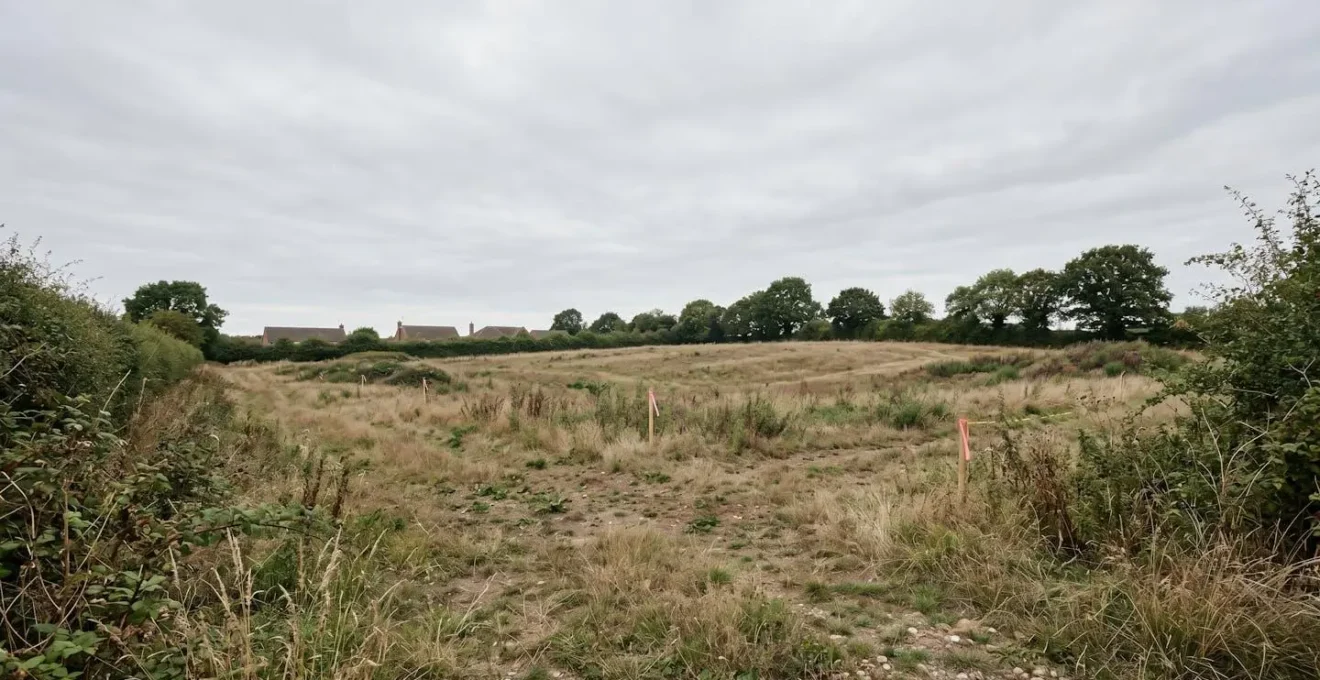
Assessing a plot is not about the view; it’s a forensic investigation to uncover the hidden financial and legal traps that can render it worthless.
- The most critical risks, such as soil contamination and restrictive covenants, are invisible and can only be found through a diligent paper trail investigation.
- Engaging with council planners (pre-app) and structural engineers early allows you to use the plot’s constraints to inform your design, not break your budget.
Recommendation: Treat every plot as guilty until proven innocent. Your primary job is not to imagine a house, but to de-risk the investment by proving there are no “development killers” lurking beneath the surface or in the fine print.
For any self-builder, it’s the pivotal moment. You’re standing on a piece of land, the sun is out, and you can already picture your future home. You’ve checked the obvious: the access seems fine, the location is good, and you can imagine the kids playing in the garden. This initial emotional response is powerful, but it’s also the most dangerous phase of purchasing land. The excitement of the potential view often blinds aspiring developers to the costly realities buried just beneath the surface or hidden within decades-old legal documents.
The common advice—check planning, look at utilities—is just the first-grade level of due diligence. The true assessment of a plot’s potential isn’t a visual inspection; it’s a forensic investigation. The most significant risks, the true “development killers,” are almost always invisible. They lie in the chemical composition of the soil, the ambiguous wording of a forgotten covenant, or the structural demands of a seemingly minor slope. A plot’s value is not determined by its visible assets, but by its lack of hidden liabilities.
This guide shifts the focus from what you can see to what you must find. It’s about adopting the mindset of a cautious, investigative land buyer. We will dissect the crucial steps to de-risk your investment, starting from the ground up with soil surveys, moving through the political landscape of planning advice, and uncovering the legal traps that can stop a project cold. This is how you determine if you’re buying a dream plot or a money pit.
This comprehensive guide details the essential investigative steps for a thorough site appraisal. By following this structure, you can systematically de-risk your potential purchase and build a clear picture of the plot’s true development potential.
Summary: A Forensic Guide to Assessing a Building Plot’s True Potential
- Why You Must Commission a Phase 1 Soil Survey Before Buying Land?
- How to Use Pre-App Advice to Test Your Design With the Council?
- Detached House or Two Semis: What Will the Planner Allow?
- The Restrictive Covenant That Could Stop You Building Anything
- How to Design a Layout That Reduces Structural Steel Costs?
- Freehold House or Leasehold Flat: Which Offers Better Security?
- How to Submit a Prior Approval Application That Gets Accepted?
- How to Convert a High Street Shop into a Flat Using Class MA Rights?
Why You Must Commission a Phase 1 Soil Survey Before Buying Land?
Before any design is considered, the investigation must start from the ground up. The soil beneath your feet holds the first and often most expensive secrets of a plot. A history of industrial use, a nearby old landfill, or even agricultural contamination can turn an affordable plot into a liability nightmare. Ignoring this step is not a calculated risk; it’s a financial gamble you will lose. The sheer scale of soil being moved and disposed of is vast; a UK government report noted that 25 million tonnes of soil went to landfill in England in 2021 alone, with remediation costs being a major factor.
A Phase 1 Contaminated Land Assessment is your first line of defence. This is not an intrusive survey; it is a desk-based study and site walkover performed by a specialist. Its purpose is to build a “Conceptual Site Model” (CSM) by investigating historical maps, environmental records, and visual evidence to identify potential sources of contamination, the pathways they could travel, and the receptors they could harm (like future residents or water sources). The report concludes with a clear risk assessment: either the site is clear, or a more expensive Phase 2 intrusive investigation (with soil and water sampling) is required.
This is a non-negotiable step. A mortgage lender will almost certainly require a clean Phase 1 report for a plot with any potential history of non-residential use. More importantly, it provides you with a powerful negotiating tool. If contamination is found, the cost of remediation—which can easily run into tens or even hundreds of thousands of pounds—can be factored into your offer or become a reason to walk away unscathed. As a buyer, you are commissioning peace of mind and financial protection.
Your 5-Step Contaminated Land Audit
- Desk Study: Review historical maps to identify past land uses (industrial sites, landfills, fuel stations) and check environmental databases for pollution incidents.
- Site Walkover: Conduct a visual inspection to confirm desk study findings and assess structures, tanks, pipework, drains, ground cover, and adjacent land uses.
- Conceptual Site Model (CSM): Identify all potential contamination sources (e.g., a former fuel tank), pathways (e.g., groundwater), and receptors (e.g., a future garden) to map out risk linkages.
- Risk Assessment Report: Receive the qualitative assessment from your surveyor, which determines whether a Phase 2 intrusive investigation is required based on the identified risks.
- Decision Point: If no significant contaminant linkages are found, proceed with confidence. If contamination is likely, commission a Phase 2 investigation for soil/groundwater sampling before committing to the purchase.
How to Use Pre-App Advice to Test Your Design With the Council?
Once you’ve started to de-risk the ground itself, the next investigation targets the local authority. “Getting planning permission” is not a single, nationwide process; it’s a highly localized negotiation influenced by the specific interpretations, priorities, and even personalities within a given council’s planning department. Believing your design is ‘good’ is irrelevant if it doesn’t align with what the local planner will allow. The disparity can be stark; for instance, analysis shows a 93% average approval rate in North East England, while some London boroughs languish at 64%.
This is where pre-application (pre-app) advice becomes an invaluable strategic tool. It is a formal, paid-for service where you can present your initial concepts to a planning officer and receive written feedback before committing to the time and expense of a full planning application. It is not about asking “Can I build a house here?”. It’s about testing specific, crucial principles: a controversial contemporary design in a traditional streetscape, a proposal for two units where one is the norm, or a plan that pushes the boundaries of the building line.
A well-prepared pre-app submission demonstrates your professionalism and respect for the process. It should include a clear site plan, basic elevations, and a short design statement explaining how your proposal responds to the local character. The feedback you receive, while not legally binding, is a powerful indicator of your chances of success. A positive response gives you confidence and can be referenced in your full application. A negative response is even more valuable; it saves you a costly refusal and provides a clear roadmap for the amendments needed to get an approval. It is the cheapest and most effective way to gauge the council’s appetite for your project.
Detached House or Two Semis: What Will the Planner Allow?
A key factor in a plot’s value is its development density—how many units can you build, and how large can they be? As a self-builder or small developer, the difference between getting permission for one large detached house versus two smaller semi-detached homes can be the entire margin of the project. This decision is not yours to make alone; it is heavily guided by the prevailing character and density of the immediate area.
Planners are tasked with preventing “over-development” and ensuring new builds are in keeping with their surroundings. To justify your proposal, you must conduct your own character appraisal. This involves systematically documenting the surrounding streetscape: plot widths, building heights, the ratio of building footprint to plot size, and architectural styles. If the street is entirely composed of two-storey, detached properties on 20-metre-wide plots, your proposal for a terrace of three-storey townhouses will almost certainly fail. Your goal is to gather precedent that demonstrates your scheme is a natural evolution of the existing pattern, not a jarring interruption.
This assessment directly impacts your financial model. A scheme with two semi-detached houses may have a higher end value, but it also means two sets of kitchen and bathroom costs, and more complex foundations. The condition of the ground, as identified in your Phase 1 survey, plays a crucial role here; a study shows that while standard foundations are manageable, poor ground conditions can easily double costs, with basic UK foundation costs ranging from £8,000 to £35,000 per unit. A single, well-engineered foundation for a detached house may be more cost-effective than two smaller, more complicated ones. The planner’s decision on density is therefore a direct lever on your project’s viability.
The Restrictive Covenant That Could Stop You Building Anything
Of all the hidden development killers, the restrictive covenant is the most insidious. This is a private legal agreement, written into the title deeds of the land, that can limit what you can do on your property. It operates completely outside of the planning system. You could have full planning permission for a two-storey house, but if a 100-year-old covenant on the deeds states “no building other than a single bungalow shall be erected,” the covenant wins. It can, and does, stop development projects dead.
These covenants are put in place by previous landowners to protect the value or amenity of their remaining land. Your solicitor’s job during the conveyancing process is to uncover these, but as a buyer, you need to be aware of the common “sleeper” covenants that can derail a project:
- ‘Single private dwelling’ restrictions: These immediately block any plans to subdivide the plot or build multiple units.
- ‘No trade or business’ clauses: A major issue in the modern era, as it could technically prevent even a home office.
- Aesthetic controls: Clauses specifying “brick construction only” or “slate roofs” can destroy a contemporary design ambition.
- Height and building line restrictions: These can dictate setbacks and maximum heights more severely than the local planning rules.
Removing or insuring against a covenant is sometimes possible, but it can be a lengthy, expensive, and uncertain process, often involving negotiations with the original beneficiary’s descendants. The presence of a restrictive covenant that directly contradicts your development plan is a major red flag. Unless you have a clear and costed legal strategy to deal with it *before* you buy, it’s often a sign to walk away.
How to Design a Layout That Reduces Structural Steel Costs?
The physical characteristics of a plot dictate the engineering of the house, and therefore a significant portion of its cost. Modern design trends favour large, open-plan spaces, which often require significant structural steel beams to support wide spans. As a cautious buyer, you should assess the plot not just for its view, but for how its topography and shape will influence the structural frame of your future building.
The most cost-effective structural designs are based on a regular, repeating grid. This means aligning load-bearing walls and keeping spans for floors and roofs relatively short and consistent. The cost of a steel beam does not increase linearly with its length; it increases exponentially. A single 6-metre beam is significantly more expensive per metre than a 4.5-metre one. By designing a layout where spans are minimised, perhaps by strategically placing an internal wall or column, you can dramatically reduce the amount and cost of structural steel.
A sloping site is a perfect example of a constraint-led design challenge. Fighting the slope with massive retaining walls and extensive “cut and fill” excavation is hugely expensive. Furthermore, stepped foundations on steep slopes can add 20-30% to substructure costs. A smarter approach is to work *with* the topography, designing a split-level or stepped house that follows the natural contours. This turns a costly problem into a unique design feature, such as a walk-out basement or terraced garden levels. Engaging a structural engineer for a brief consultation before you finalise your design is one of the best investments you can make, allowing you to optimise the structure for cost-efficiency from the very beginning.
Freehold House or Leasehold Flat: Which Offers Better Security?
The question of tenure—what you legally own—is a fundamental aspect of a plot’s value and security. For a standalone house on its own plot, the goal is always to secure the freehold. This means you own the building and the land it stands on outright, in perpetuity. It offers maximum security and control. However, the world of land acquisition is filled with tenure traps that can severely complicate or devalue your project.
A leasehold interest, more common with flats, means you only own the right to occupy the property for a set number of years. Buying a leasehold plot to build on is highly unusual and fraught with risk. If the lease is already short (under 80 years), the finished property will be difficult to mortgage and sell. Another significant trap is the “flying freehold,” where part of your property extends over or under a neighbour’s freehold land. This creates legal and mortgage complexities that many lenders will not touch.
The most diligent paper trail investigation is required to uncover these tenure traps before purchase. Your solicitor must meticulously review the title plan and deeds for any signs of:
- Ransom Strips: Small, seemingly insignificant strips of land between your plot and the public highway owned by a third party, who can then demand a huge sum for access rights.
- Complex Lease Structures: If you are building flats, you will be creating a new leasehold structure. This involves setting up a management company and service charge framework, a significant administrative and legal burden.
- Easements and Wayleaves: Rights granted to others (e.g., utility companies to run pipes, or neighbours to cross your land) that can restrict where and how you can build.
The security of your investment is only as good as the title you hold. A clean, unencumbered freehold title is the gold standard, and any deviation from this must be investigated with extreme caution.
How to Submit a Prior Approval Application That Gets Accepted?
In some specific circumstances, you may be able to bypass the full planning permission process through “Permitted Development Rights” (PDR). However, for many of these rights, you don’t get a free pass; you must first submit a Prior Approval application. This is a lighter-touch process where the council only considers a limited number of specific factors, such as transport impact, contamination, or noise, rather than the full principle of development.
Class MA, for converting commercial properties to residential, is a key example that requires Prior Approval. The process is faster and less subjective than a full planning application, but it is not a rubber stamp. You must provide robust evidence to satisfy the council on all the specified matters. If your evidence is weak—for example, if your noise assessment for a ground-floor flat below an office is inadequate—the council can, and will, refuse Prior Approval.
Getting this application right the first time is critical. While you can appeal a refusal, it’s a slow and uncertain route. The odds are not in your favour; Planning Inspectorate data reveals that only about one appeal in three is successful, and the process can take many months, killing your project’s momentum. A successful Prior Approval application is therefore about meticulous preparation. It requires a “belt and braces” approach: commissioning professional reports for any contentious issues (like noise or highways), providing clear and unambiguous plans, and methodically ticking every box on the council’s checklist. It’s a test of diligence, not design flair.
Key Takeaways
- True plot assessment is a forensic investigation into hidden risks like contamination and covenants, not a simple visual inspection.
- Your most critical tools are not a spade and a tape measure, but historical maps, legal deeds, and the council’s online planning portal.
- Engage with planners (pre-app) and engineers early to let the plot’s constraints inform your design, not break your budget after purchase.
How to Convert a High Street Shop into a Flat Using Class MA Rights?
One of the most significant Permitted Development Rights introduced in recent years is Class MA. This right allows for the conversion of commercial properties (within Class E, which includes shops, offices, and restaurants) into residential dwellings (Class C3) without needing full planning permission. For a small developer, this can be a golden opportunity to acquire a high street property and convert it into valuable flats. However, the eligibility criteria are strict and absolute, requiring a “Day Zero” paper trail of due diligence.
To qualify for Class MA, you must provide indisputable evidence that the property meets several non-negotiable conditions. The entire process hinges on the paper trail you can assemble *before* submitting your Prior Approval application. Key evidence includes:
- Qualifying Use: You must prove the property was in Class E use for a continuous two-year period. Business rate bills are the best evidence for this.
- Vacancy Period: The property must have been vacant for a continuous period of at least three months immediately before the date of the application. Dated estate agent listings or utility bills can prove this.
- Size Limitations: The cumulative floorspace to be converted must not exceed 1,500 square metres. You’ll need accurate floor plans to prove this.
- Disqualifying Designations: The property must NOT be in a Conservation Area, an Area of Outstanding Natural Beauty (AONB), a National Park, or be a listed building. Any of these designations instantly eliminates Class MA rights.
Even if you meet all these planning criteria, you must also consider Building Regulations. You will still need to prove that you can achieve adequate fire separation, sound insulation (especially from any remaining commercial units), and safe access for the residential units. Class MA is a powerful tool for bypassing subjective planning arguments, but it replaces them with a rigid, evidence-based gauntlet. Your ability to build a robust file of evidence is the only thing that matters.
Armed with this investigative framework, your next step is to apply it. Start your paper trail investigation on a target plot today, and move forward with the confidence that comes from rigorous due diligence, not wishful thinking.