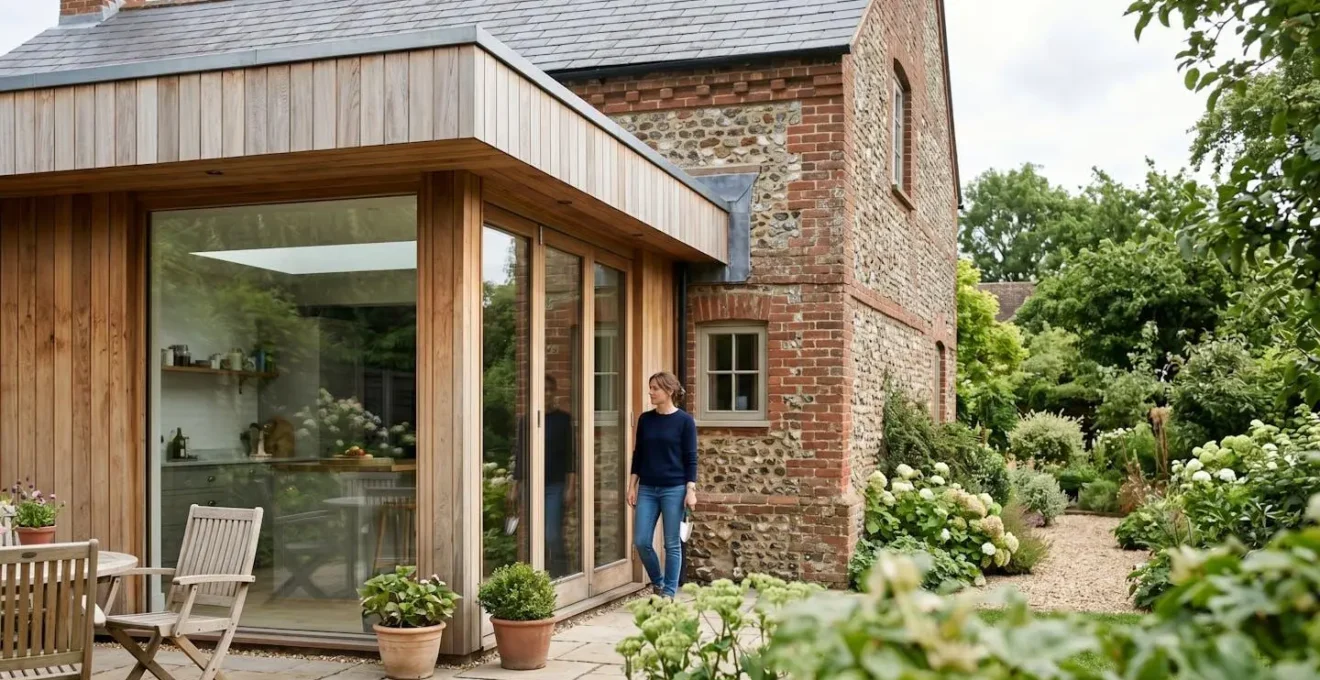
Choosing a timber frame isn’t just about speed; it’s about gaining more usable, energy-efficient living space from a smarter, engineered system.
- Timber frame walls are up to 30% thinner than masonry for the same insulation level, directly adding to your internal floor area.
- The construction process is a system. A watertight structure can be achieved in days, but this speed depends entirely on getting the moisture protection details right.
Recommendation: Focus on finding a builder who understands the entire ‘building fabric’ as a system, not just a structure. This is the key to unlocking the full performance benefits.
The dream of extending your home often starts with visions of light-filled spaces and more room for your family. But that dream can quickly meet the daunting reality of a long, messy, and disruptive build. For decades, the default choice in the UK has been traditional brick and block masonry, prized for its feeling of permanence. The alternative, timber frame, is often simply labelled as ‘the fast one’.
This simplistic view misses the point entirely. The discussion shouldn’t be about ‘fast vs. solid’ but about ‘system performance vs. conventional methods’. A modern timber frame extension is a highly engineered system designed for thermal efficiency, airtightness, and predictable construction. It’s not just a collection of wooden sticks; it’s a sophisticated building fabric that can outperform masonry in several key areas, especially when you’re adding it to an older property like a semi-detached house.
But what about the perceived risks? The fears around fire, rot, and getting planning permission for timber cladding in a neighbourhood of brick are valid concerns. The truth is, these are solvable engineering challenges. This article moves beyond the platitudes to give you, the homeowner, an honest assessment. We’ll delve into the science behind why timber frames are thinner, how they achieve superior weather protection, and how they synergise perfectly with modern, low-carbon technologies like heat pumps.
By understanding the complete system—its strengths and its critical details—you can make an informed decision that goes beyond tradition and focuses on creating a truly high-performance, comfortable, and sustainable living space for years to come.
To help you navigate this decision, this guide breaks down the essential questions you should be asking. Explore the key comparisons, challenges, and benefits of timber frame construction in the sections below.
Summary: The Complete Guide to Choosing a Timber Frame Extension
- Why Timber Frame Walls Are 30% Thinner for the Same Insulation?
- How to Get Planning Permission for Timber Cladding in a Brick Area?
- Is Timber Frame Construction Really a Fire Risk for Residential Homes?
- The Weather Protection Mistake That Ruins Timber Frames During Build
- How to Make Your House Watertight in Just 5 Days with Timber Frame?
- Why Sealing Up an Old House Can Cause Black Mould in 6 Months?
- Do Air Source Heat Pumps Actually Work When It Hits -5°C?
- How to Retrofit a Victorian Terrace to EPC C Without Losing Character?
Why Timber Frame Walls Are 30% Thinner for the Same Insulation?
The single most compelling, yet often overlooked, advantage of timber frame is gaining internal space. This isn’t magic; it’s physics. In a traditional masonry cavity wall, the blocks and bricks are primarily for structure, while a relatively thin layer of insulation is squeezed into the gap. In a timber frame wall, the entire depth of the structural timber stud can be filled with insulation. This means the material doing the structural work is also housing the material doing the thermal work, creating an incredibly efficient, multi-functional wall.
The result is a significantly thinner wall assembly for the same, or even better, thermal performance (U-value). For a homeowner, this is a direct, tangible benefit. An equivalent timber frame wall can be as little as 200mm wide compared to 350mm for a typical masonry construction. While 150mm might not sound like much, when you apply that saving across the entire perimeter of your extension, you are gaining significant, valuable internal floor space—often enough for a larger sofa, a deeper worktop, or simply a more spacious feel.
This table illustrates how different wall constructions compare in achieving modern insulation standards. Notice how timber frame and SIPs (Structurally Insulated Panels) can achieve excellent U-values with a much slimmer profile, as shown in this comparative analysis.
| Construction Type | Insulation Material | Total Wall Thickness | U-value (W/m²K) |
|---|---|---|---|
| Masonry Cavity | Mineral Wool (filled cavity) | 312mm | 0.18-0.20 |
| Timber Frame (140mm stud) | Mineral Wool | 225mm | 0.19-0.29 |
| SIPs Panel (140mm) | Polyurethane | 220mm | 0.19 |
| Timber Frame Enhanced | PIR Insulation | 200mm | 0.18 |
This efficiency is a core principle of modern construction. By integrating structure and insulation, you avoid redundant layers and create a leaner, harder-working building fabric. It’s a clear example of how choosing a different construction method can fundamentally change the quality and quantity of the space you are paying to build.
How to Get Planning Permission for Timber Cladding in a Brick Area?
One of the biggest anxieties for homeowners is the planning process. You’ve chosen a timber frame extension for its performance, and you want the exterior to reflect that modern, natural aesthetic. But what if your house is in a street dominated by traditional brick? Getting approval for timber cladding can seem like an uphill battle, but it’s entirely achievable with the right strategy. Planning departments are not inherently against timber; they are against poor or inappropriate design.
The key is to present your choice not as a jarring interruption, but as a “respectful contrast.” You must demonstrate that you have considered the local context and are proposing a high-quality, contemporary addition that complements the existing brickwork. This involves building a robust case in your Design and Access Statement, focusing on materiality, weathering, and precedent. Showing how the timber will age gracefully to a subtle silver-grey, rather than being left to deteriorate, is crucial.
As the image shows, the natural weathering process of timbers like cedar or larch is a beautiful and important part of the story. Presenting this progression to planners can help them visualise the long-term aesthetic and appreciate the material’s quality. Rather than fighting the brick, you are proposing a dialogue between the warm, textured heritage material and the clean, elegant lines of modern timber.
Your Action Plan for Planning Approval
- Research precedent: Search your local council planning portal for previously approved applications using timber cladding in your area. Use these as evidence.
- Craft a compelling narrative: In your Design and Access Statement, frame the timber as a high-quality, sustainable material that respectfully contrasts with historic brickwork.
- Specify weathering characteristics: Detail the timber species (e.g., Larch, Cedar) and show how its natural change to a silver-grey patina will provide a subtle, long-term aesthetic.
- Provide physical samples: Present material samples to planning officers to demonstrate the quality and intended appearance, both new and after weathering.
- Address material matching: Show how the timber can sit alongside existing properties or how sections can be clad in brick or render to create a harmonious blend.
Is Timber Frame Construction Really a Fire Risk for Residential Homes?
The fear of fire is primal, and the idea of a wooden house naturally triggers concern. This is perhaps the most persistent myth surrounding timber frame construction, rooted in images of historical fires rather than the reality of modern building science and regulations. The simple truth is: a modern, code-compliant timber frame home is designed to be just as fire-safe as a masonry one. The strategy is just different.
A masonry wall works by being non-combustible. A timber frame wall system works by a combination of fire resistance and compartmentalisation. The structural timber is protected by layers of fire-resistant plasterboard. Building Regulations dictate the specific thickness and type of plasterboard required to provide a minimum of 30 or 60 minutes of fire protection, giving occupants ample time to escape before the structure is compromised. All voids within the wall are also fitted with fire stops to prevent the spread of flames and smoke.
Furthermore, the structural timber itself has inherent fire-resistant properties that are often underestimated. This is particularly true for larger section timbers, as explained by experts in the field.
Large timbers used for framing are naturally fire-resistant. They resist fire for an extended period because of the charring effect: where the char on the outside insulates the interior of large pieces of timber.
– Hamill Creek Timber Frame Construction, Timber Frame Construction & Building Codes
This charring effect is a critical concept. When exposed to fire, the outer layer of the wood burns and turns into a layer of char. This char acts as a natural insulator, slowing down the rate at which the fire can penetrate and weaken the core of the timber. This gives the structure a predictable and reliable level of performance in a fire, which is the cornerstone of modern fire safety engineering.
The Weather Protection Mistake That Ruins Timber Frames During Build
If there is an Achilles’ heel to timber frame construction, it is not fire, but uncontrolled moisture during the build phase. This is the honest, practical part of the conversation every homeowner needs to have with their builder. The fantastic speed of timber frame construction is only a benefit if the material is protected. The single biggest mistake is allowing the prefabricated frame to be exposed to rain for prolonged periods on site.
Wood is a natural material; it can get wet and dry out without issue. The problem arises when it gets wet and *stays* wet. When timber remains at a moisture content of 20% or more, it creates the perfect conditions for fungal growth and rot to begin. This is a critical threshold that must be managed.
The mistake often happens due to poor project management. A timber frame is delivered to a site where the foundations aren’t quite ready, or the roof covering is delayed. The frame is then left sitting, sometimes inadequately covered with non-breathable plastic sheeting which can trap condensation and make the problem worse. The proper protection is a breathable membrane, correctly installed at the factory or immediately on-site, which allows any trapped moisture vapour to escape while shedding liquid water.
The Critical Role of On-Site Moisture Management
Industry guidance from sources like the NHBC reveals a clear risk: timber with 20% or more moisture content for extended periods is vulnerable to fungal degradation. The crucial error is not the rain itself, but the lack of readiness on-site that forces exposure. Frames should only be delivered when the site is 100% prepared to receive them and get them covered. Using non-breathable tarps is a false economy; they often trap moisture from the ground and create a humid microclimate, which is far more damaging than direct rain on a frame that can dry quickly.
International standards recognise the importance of this stage. It’s not a casual recommendation; it’s a core requirement for a durable building.
When transporting, storing and installing timber, suitable measures are to be implemented to ensure that their moisture content does not change to an unacceptable extent due to adverse external influences such as precipitation or adjacent building components.
– DIN 68800-2:2022-02, German Standard for Wood Preservation in Buildings
How to Make Your House Watertight in Just 5 Days with Timber Frame?
The promise of speed is the most famous advantage of timber frame construction, and for good reason. In a world of lengthy, disruptive home-building projects, the ability to have a watertight structure in under a week is transformative. This isn’t an exaggeration; it’s a direct result of moving a significant portion of the construction process from a muddy, weather-dependent building site into a controlled factory environment.
While a traditional build proceeds brick by brick, a timber frame extension arrives on-site as a kit of large, prefabricated panels. These panels—which can include walls, floors, and the roof—are craned into place and assembled in a matter of days. This rapid erection means the building can be made weathertight very quickly. Once the roof membrane is on and windows are in, the interior is protected from the elements. This allows interior trades like electricians and plumbers to start work much earlier in the project timeline, regardless of the weather outside.
This overlapping of trades is what creates the huge time savings. Overall, timber frame buildings can be erected 30-50% faster than traditional brick and block builds. For a homeowner living on-site, this dramatic reduction in the construction schedule means less noise, less disruption, and a quicker return to normal life.
The image of a coordinated team quickly assembling a home is the reality of a well-planned timber frame project. It is a system built on precision and planning. The accuracy of factory production means fewer on-site errors and a more predictable build. This speed is a direct benefit to your project’s bottom line—reducing labour costs, management time, and the length of any alternative accommodation you might need.
Why Sealing Up an Old House Can Cause Black Mould in 6 Months?
You’ve built a beautiful, high-performance timber frame extension. It’s warm, airtight, and incredibly energy-efficient. But it’s attached to your existing semi-detached house, which is likely to be much less so. This interface between the “new” and the “old” is a critical point that, if misunderstood, can lead to unintended consequences like damp and black mould.
Older houses were designed to be “leaky.” They managed moisture by allowing a constant, uncontrolled flow of air through gaps and cracks. When you build a very airtight extension and dramatically improve the insulation in that part of the house, you change the building’s thermal dynamics. The coldest surfaces in your home are no longer evenly distributed; they are now concentrated in the uninsulated parts of the original house. Warm, moist air from modern living (cooking, showering, breathing) will travel from the new, warm extension and find these cold surfaces in the old part of the house. When it does, the moisture in the air will condense, creating damp patches and the perfect breeding ground for black mould.
This is not a fault of the extension; it’s a symptom of an unbalanced system. It highlights the importance of seeing your house as a single, holistic entity. Simply sealing up one part without considering the whole can be counterproductive. Uninsulated walls can lose up to 30% of a home’s heat, making them prime candidates for condensation when a super-insulated extension is added next to them.
The solution is not to make your extension less efficient. The solution is to have a whole-house ventilation strategy. This could involve adding background vents to windows in the older rooms, installing extractor fans in kitchens and bathrooms, or considering more advanced Mechanical Ventilation with Heat Recovery (MVHR) systems. The key is to manage the moisture at its source and ensure that while you are stopping uncontrolled draughts, you are providing controlled, planned ventilation.
Do Air Source Heat Pumps Actually Work When It Hits -5°C?
As we move away from fossil fuels, air source heat pumps are becoming the default choice for new, efficient heating systems. However, a common criticism is that they struggle in cold weather. The question of whether they work at -5°C is a valid one, but it misses the point. The real question is: how hard does the heat pump have to work? And the answer to that lies in the quality of your building fabric.
A heat pump’s efficiency is directly related to the temperature of the water it produces for your radiators or underfloor heating. They are at their most efficient when running at a low, constant flow temperature (e.g., 35-45°C), rather than the high-temperature blasts of a traditional gas boiler (60-70°C). A heat pump can absolutely produce heat at -5°C, but to do so efficiently, it needs to be paired with a house that doesn’t leak heat like a sieve. This is where the synergy with timber frame becomes so powerful.
The Heat Pump and Building Fabric Partnership
A high-performance timber frame, with its excellent insulation and airtightness, creates a building with very low heat demand. This allows a heat pump to do its job with ease. As analysis of high-performance timber frames shows, achieving U-values below 0.18 W/m²K is standard. This exceptional thermal performance means the heat pump can operate at its optimal low flow temperatures, significantly reducing running costs. System “failures” in cold weather are almost always due to a mismatch between the heat pump and a poorly insulated building, not a failure of the technology itself.
A highly insulated timber frame extension is the perfect partner for a heat pump. The low heat loss of the structure allows the heating system to tick over gently and efficiently, providing a constant, comfortable warmth. Trying to run a heat pump in a leaky, uninsulated house is like trying to fill a bucket with a hole in it—you’ll get there, but it will be a constant, expensive struggle.
A highly insulated timber frame extension with minimal heat loss is the perfect partner for a heat pump, allowing it to run efficiently at a low, constant flow temperature.
– Sustainable Building Expert Analysis, Timber Frame Thermal Performance Review
Key Takeaways
- A timber frame’s primary benefit is space: its thinner walls provide more usable floor area for the same level of insulation.
- Success depends on systems thinking: from planning approval to pairing with a heat pump, every element is connected.
- Moisture management during the build is non-negotiable; a builder’s plan to protect the frame from rain is a key quality indicator.
How to Retrofit a Victorian Terrace to EPC C Without Losing Character?
The principles that make a timber frame extension so high-performing—good insulation, airtightness, and controlled ventilation—can and should be applied to the rest of your home. For owners of older properties like Victorian terraces, the challenge is upgrading energy performance to modern standards (like an EPC C rating) without stripping away the period details that give the house its soul. It is a delicate balancing act, but far from impossible.
The goal is to make “invisible upgrades.” This means swapping bulky, inefficient elements for sleek, high-performance alternatives that respect the original architecture. Bulky radiators can be replaced with underfloor heating, preserving precious wall space. Original sash windows, a key feature of Victorian homes, don’t need to be ripped out for ugly uPVC. They can be replaced with slim-profile double-glazed units that replicate the original details, or carefully refurbished with draught-proofing.
When it comes to insulating solid brick walls, the fear is losing internal space or covering up features like cornices and picture rails. However, modern materials like ultra-thin insulated plasterboards allow for a significant thermal upgrade with minimal loss of space. Furthermore, using breathable insulation materials like wood fibre or cork, finished with a traditional lime plaster, works with the building’s natural ability to manage moisture, preventing the issues that can arise from sealing it in plastic-based insulation. The savings are real; a retrofit case study analysis showed annual savings of up to 25% on heating bills for a semi-detached home that upgraded its insulation.
A successful retrofit is about a series of considered, sensitive interventions, not a single, brutal overhaul. The following strategies can form part of a whole-house plan:
- Strategy 1: Install high-performance slim-profile double glazing that replicates original sash window details.
- Strategy 2: Replace bulky radiators with underfloor heating to preserve wall space and architectural features.
- Strategy 3: Use advanced ultra-thin insulated plasterboards to insulate walls while preserving original cornices.
- Strategy 4: Apply breathable insulation materials like wood fibre and cork that maintain the building’s ability to manage moisture naturally.
- Strategy 5: Develop a phased Whole House Plan to integrate energy improvements with renovation cycles.
Ultimately, whether you choose timber frame or masonry, the goal is to create a space that is comfortable, efficient, and built to last. By understanding the underlying principles of modern building science, you are better equipped to ask the right questions and ensure your extension project is a true success, from the foundations to the final heating bill.