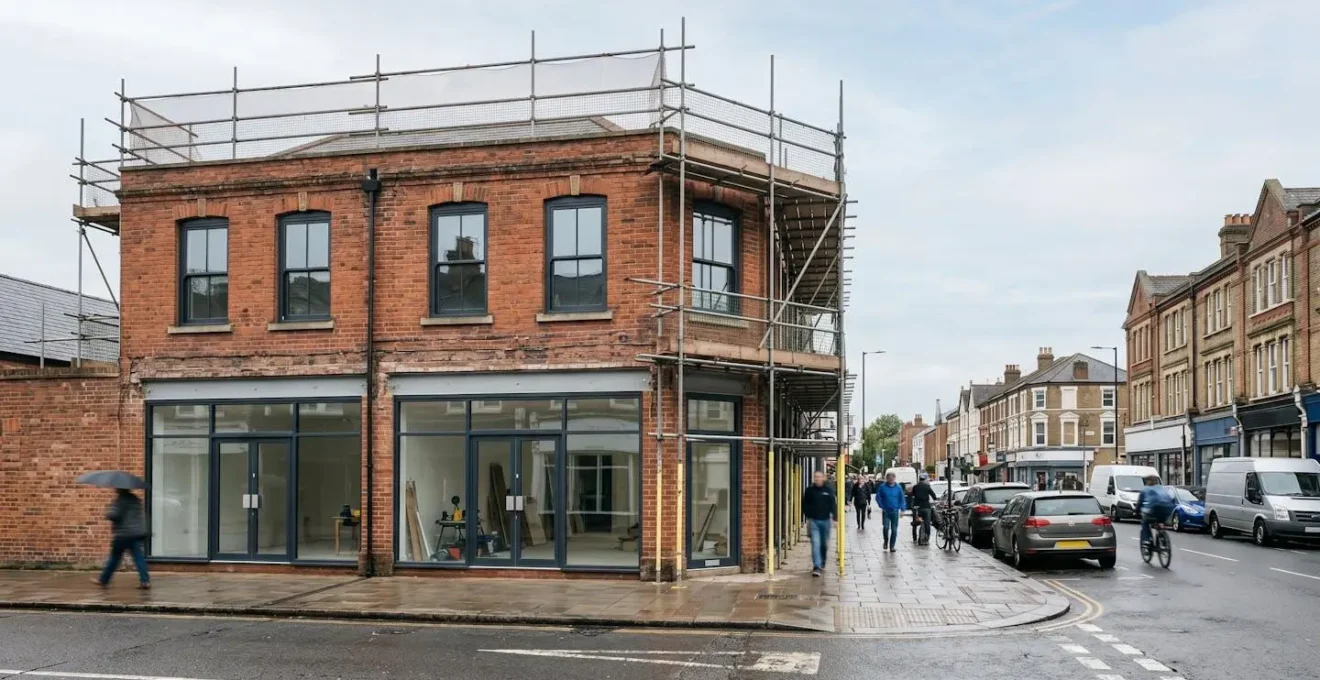
Class MA permitted development is more than a planning shortcut; it’s a strategic test of a project’s real-world viability, where profit lies in pre-emptively solving noise, light, and layout issues before application.
- Success hinges on moving beyond a checklist approach to actively de-risking “hidden hurdles” like acoustic performance and natural light provision.
- The most profitable conversions come from strategic asset selection, identifying buildings with inherent structural advantages for residential layouts.
Recommendation: Prioritise a thorough pre-acquisition audit focusing on structural adaptability and potential compliance failures over simply confirming Class E status.
The sight of shuttered shops on UK high streets presents a significant challenge, but for the astute property developer, it also signals a prime opportunity. The government’s introduction of Class MA permitted development rights (PDR) was designed to streamline the conversion of these vacant commercial spaces (Use Class E) into much-needed housing. Many see this as a simple administrative shortcut, a way to bypass the complexities of a full planning application. This is a common and costly misconception.
While the process is indeed faster, success is not guaranteed by a simple form-filling exercise. The reality is that a prior approval application is a rigorous test of a project’s viability. The councils are not merely ticking boxes; they are scrutinising key aspects that can halt a project in its tracks, from noise impact and transport to contamination and natural light. Relying on the legislation’s text alone without understanding the practical pitfalls is a direct route to refusal and wasted capital.
The true key to unlocking profit from Class MA is not in just following the rules, but in mastering a strategy of proactive de-risking. This means identifying and solving the “unwritten” problems—the practical, physical, and financial hurdles—long before an application is submitted. It requires a shift in mindset from “Can I get permission?” to “Can I create a compliant, desirable, and profitable residential asset?”.
This guide moves beyond the legislative basics to provide a strategic framework for developers. We will dissect the critical factors that determine success, from a financial and planning perspective. We’ll explore which assets are genuinely easier to convert, how to navigate the common points of failure like noise assessments, and when to acquire distressed properties to maximise your return on investment. This is your blueprint for turning empty commercial space into a successful residential development.
Summary: Converting Commercial Property to Residential Under Class MA
- Why Converting Offices to Flats Offers Higher Yields Than New Builds?
- How to Submit a Prior Approval Application That Gets Accepted?
- Retail Unit or Office Block: Which Is Easier to Convert to Housing?
- The Noise Assessment Failure That Can Stop Your Conversion
- When to Buy Distressed Commercial Assets for Maximum Upside?
- Why Buying Early in a Regeneration Zone Can Yield 15% Growth?
- Detached House or Two Semis: What Will the Planner Allow?
- How to Profit from Off-Plan Property in Manchester’s Regeneration Areas?
Why Converting Offices to Flats Offers Higher Yields Than New Builds?
The primary driver for any development project is its financial viability, and office-to-residential conversions present a compelling case. The fundamental advantage lies in acquiring an existing structure at a lower capital cost compared to a vacant plot of land destined for a new build. This immediately reduces initial outlay and associated financing costs. The value uplift created through the change of use is where the significant profit is generated. For instance, industry analysis shows that a commercial property valued at £100-£150 per sq ft can see its value leap to £300-£500 per sq ft once converted to residential use, a multiplier effect that is difficult to achieve with new construction.
Furthermore, the speed of delivery through permitted development rights accelerates the return on investment. A full planning application can be a lengthy and uncertain process, whereas the statutory determination period for a prior approval application offers a much clearer timeline. This speed is critical in a market where holding costs can erode profitability. Government statistics underscore the scale of this trend, confirming that 5,154 dwellings were created from former offices in 2024-25 alone under PDR.
Real-world projects validate this model. Consider the £3m conversion of an office building on City Road near Old Street, London. The developer secured funding to transform the property into 21 flats under permitted development. This project capitalises directly on the trend of converting secondary office space in high-demand urban areas into valuable housing, demonstrating a clear and profitable exit strategy that is often faster and more certain than starting from scratch.
Ultimately, conversions offer a unique blend of lower acquisition costs, significant value uplift, and a faster development cycle. For developers who can master the specific challenges of PDR, the yields often surpass those of traditional new-build projects, which are frequently burdened by higher land costs and longer planning timelines.
How to Submit a Prior Approval Application That Gets Accepted?
Submitting a prior approval application under Class MA is not a passive, box-ticking exercise; it is an active process of proving to the local planning authority that your proposed development will not have adverse impacts. The key to acceptance is a robust, evidence-based submission that pre-emptively addresses all potential points of contention. A weak or incomplete application is an invitation for refusal or, at best, a request for more information that delays the statutory 56-day determination period for such conversions.
The first non-negotiable step is confirming eligibility. The building must have been in Use Class E for a continuous period of at least two years and must not fall into any excluded categories, such as being a listed building or located in a Site of Special Scientific Interest (SSSI). Assuming the building qualifies, your focus must shift to the matters requiring prior approval: transport impacts, contamination risks, flood risk, noise from surrounding commercial premises, and the provision of adequate natural light to all habitable rooms.
Of these, adequate natural light and noise impact are the most common failure points. You cannot simply state that the rooms will have windows; you must provide scaled floor plans and analysis demonstrating that every habitable room meets recognised standards, such as those set by the BRE guidance. A thorough, defensible application is your best insurance against refusal. It demonstrates professionalism and leaves the planning officer with a clear, evidence-led path to granting approval.
Your Action Plan for a Defensible Prior Approval Application
- Verify Eligibility: Confirm the building has been in Use Class E for a minimum of two years and is not in an excluded area (listed building, SSSI, safety hazard zone, etc.).
- Compile Core Documents: Prepare the required evidence base, including a flood risk assessment, contamination report, transport impacts assessment, and a detailed noise assessment.
- Prove Natural Light: Commission and submit a comprehensive natural light analysis, demonstrating that all proposed habitable rooms meet or exceed established standards.
- Manage the Timeline: Note that the 56-day determination period begins the day after a valid application is submitted. If no decision is issued within this timeframe, you may have grounds to apply for deemed consent.
- Complete within Three Years: Once prior approval is granted, the development must be completed within three years from that date.
Retail Unit or Office Block: Which Is Easier to Convert to Housing?
The question of whether a high street retail unit or a larger office block is “easier” to convert is complex; there is no single answer. The reality is that each presents a distinct set of structural and design challenges. The “easier” project is the one whose inherent characteristics best align with the requirements for creating high-quality residential space. A developer’s success depends on correctly identifying these challenges during due diligence.
Office blocks often suffer from deep floor plates, where the distance from the building’s core to the windows is significant. This makes it incredibly challenging to design residential units where all habitable rooms receive adequate natural light, a key requirement for prior approval. While their generous ceiling heights and structural grids can be an advantage, overcoming the natural light issue can require clever—and often costly—design solutions, such as creating internal light wells.
This paragraph introduces the concept of deep floor plates. For a clearer understanding, the illustration below highlights the challenge of getting natural light into the core of such a building.
As the schematic shows, light penetration diminishes rapidly, leaving the central areas of a deep floor plate unsuitable for habitable rooms without significant intervention. Retail units, on the other hand, often present a different problem: long, narrow layouts, sometimes described as ‘bowling alleys’. While they may have good light at the front and potentially the rear, creating well-proportioned, functional living spaces can be difficult. Ground-floor retail conversions also face greater scrutiny regarding noise, privacy from the street, and the need to maintain an “active frontage” that doesn’t deaden the high street.
The following table, based on an analysis from architectural practice Formi, summarises the key trade-offs between these two asset types.
| Factor | Office Conversion | Retail Conversion |
|---|---|---|
| Structural Challenges | Deep floor plates, complex service cores, curtain walling systems | Large glass fronts, deep ‘bowling alley’ layouts, single-frontage constraints |
| Layout Potential | Better suited for creating multiple well-proportioned units | Often forced into design compromises, creates unique but sometimes awkward single units |
| Natural Light | Greater challenge demonstrating adequate natural light, especially upper floors | Easier access to natural light, especially upper floors above shops |
| Planning Scrutiny | Focus on adequate natural light and space standards | More scrutiny on noise, privacy, and maintaining active frontages (ground floor) |
The Noise Assessment Failure That Can Stop Your Conversion
Among the technical hurdles of a Class MA conversion, the noise assessment is one of the most frequent and decisive points of failure. An application can be refused solely on the grounds that the future residents would be unacceptably affected by noise from surrounding commercial premises. This is particularly critical for high street locations with bars, restaurants, and delivery traffic. A developer cannot simply hope for the best; you must adopt a design-led compliance approach from the very beginning.
This means the noise assessment should not be a last-minute report but a tool that informs the building’s design. The goal is to demonstrate that internal noise levels can meet the targets recommended in guidance like BS 8233: typically 35dB for daytime living rooms and 30dB for night-time bedrooms. Achieving this often requires more than just standard double glazing. It involves a holistic strategy that considers building layout, elevation treatment, glazing specification, and ventilation.
Engaging a qualified acoustic consultant, ideally accredited by the Association of Noise Consultants (ANC), is a non-negotiable investment. They can conduct a pre-feasibility survey even before you acquire the asset, identifying potential “show-stopper” noise sources. Their input is crucial for developing a defensible mitigation strategy. This could involve positioning less sensitive rooms like bathrooms and hallways as buffer zones, placing bedrooms on quieter elevations, or specifying high-performance acoustic glazing and ventilation systems. It’s also vital to address internal sound transmission between flats. Under building regulations, Part E stipulates a maximum impact sound level of 64dB for floors in conversion projects, a standard that must be designed for.
A proactive approach to acoustics is essential. Here are some key design strategies to discuss with your architect and acoustic consultant:
- Create Buffer Zones: Position hallways, storage areas, or bathrooms between external noise sources and sensitive rooms like bedrooms.
- Strategic Room Placement: Locate bedrooms on quieter elevations, away from main roads or noisy ground-floor commercial units.
- Specify Acoustic Glazing: Select glazing appropriate to the specific type of external noise (e.g., traffic vs. industrial sources).
- Plan Ventilation Early: Choose a ventilation strategy (e.g., acoustic trickle ventilators or Mechanical Ventilation with Heat Recovery) that allows internal noise targets to be met, even if windows need to remain closed.
- Address Internal Sound: Ensure separating walls and floors are designed to meet or exceed the standards of Approved Document E for both airborne and impact sound.
When to Buy Distressed Commercial Assets for Maximum Upside?
The greatest financial upside in commercial-to-residential conversions often comes from acquiring assets at the right moment—typically when the current owner is most motivated to sell. This requires an understanding of the market pressures forcing commercial landlords to divest. The ongoing shift in retail and office use has created a pool of “distressed” assets ripe for conversion. With recent market data revealing the UK lost 37 shops per day in 2024, the supply of vacant retail space is continually growing.
Similarly, in the office sector, the move towards hybrid working has rendered vast quantities of older office stock obsolete. The British Property Federation estimates that over 20 million+ sq ft of UK office space is obsolete or underutilised. Upcoming deadlines for commercial EPC ratings (requiring a minimum ‘C’ rating by 2027 and ‘B’ by 2030) will place further pressure on landlords of older, inefficient buildings, creating a prime opportunity for developers to acquire these assets at a discount.
The ideal time to buy is when you can identify a property with strong “conversion fundamentals” that is being sold by a motivated party. This could be a landlord facing an imminent lease break with no new tenant lined up, or one unwilling to invest the capital required to meet new energy efficiency standards. However, a low price does not automatically equal a good opportunity. A rigorous asset triage process is essential to separate genuine bargains from potential money pits. This involves a deep dive into the building’s physical and legal constraints before committing to a purchase.
Your due diligence must go far beyond simply confirming its Use Class E status. It should be a forensic examination of the building’s suitability for residential life. This includes assessing the structural grid for layout flexibility, evaluating the capacity of existing utilities to handle a residential load, and confirming that fire escape routes and access rights are compliant for residential use. Ignoring these factors can lead to unforeseen costs that wipe out any potential profit from the conversion.
Why Buying Early in a Regeneration Zone Can Yield 15% Growth?
Acquiring a commercial property for conversion is not just about the building itself; it’s about investing in its future location. Buying into an area at the early stages of a planned regeneration scheme can act as a powerful value multiplier, potentially adding 15% or more to the end value of your development. Regeneration brings improved infrastructure, better public transport, new amenities, and an overall uplift in the desirability of a neighbourhood, all of which directly translate into higher residential property values and rental yields.
The key is to identify these zones before the market fully prices in the future growth. This involves studying local authority strategic plans, masterplans, and infrastructure investment announcements. For example, a major transport upgrade or the development of a new university campus can transform the prospects of an entire district. Developers who do this homework can acquire assets at a pre-regeneration price and benefit from the subsequent uplift as the area improves.
This is a strategy actively employed by institutional investors. A recent audit by Lambert Smith Hampton identified 12.9 million sq ft of office space across the South East prime for permitted development conversion, with the largest opportunities concentrated in areas like Reading and the Blackwater Valley—both targets of significant ongoing investment and regeneration. This approach demonstrates a large-scale application of the principle: find markets with a combination of under-utilised building stock and a clear pipeline of public and private investment.
This strategic approach to site selection shows the power of combining macro-level analysis with asset-specific opportunities.
Permitted development has historically been a major contributor to housing supply, with government data showing a peak of 17,751 new homes delivered via office conversions in 2016-17. By targeting conversion opportunities within designated regeneration zones, developers can ride the wave of area-wide improvement, ensuring their finished units command the highest possible price and appeal to a growing pool of buyers and renters drawn to the newly revitalised location.
Detached House or Two Semis: What Will the Planner Allow?
While the title poses a question about subdivision, a more relevant strategic decision for a Class MA conversion is about the type and number of units to create: one large, high-value luxury unit or multiple smaller, more lettable apartments? This choice has profound implications for your target market, sales velocity, rental yield, and even the planning process itself. It’s a classic trade-off between maximising absolute sale price and optimising rental income and risk diversification.
Creating a single, large, loft-style apartment can capitalise on the unique character of a former commercial building—high ceilings, large windows, and open-plan spaces. This appeals to a niche buyer pool seeking a unique property and can command a high absolute sale price. However, this niche market is smaller, which can mean a longer time on the market to find the right buyer. The rental yield as a percentage of value is also typically lower for high-value single units.
Conversely, subdividing the space into two or more smaller apartments opens up a much broader market of first-time buyers and buy-to-let investors. While the price per unit is lower, the sales velocity is often faster, and the combined rental income is usually higher. With data indicating an 8.3% year-on-year rental price increase in 2024, maximising rental yield is a powerful strategy. Creating multiple units also diversifies your risk; a void period in one unit is less damaging than having your single luxury unit sit empty. From a planning perspective, however, creating multiple units receives more scrutiny regarding issues like bin storage, cycle parking, and potential increased density.
The optimal strategy depends heavily on local market dynamics. An analysis of local housing needs and sales data is crucial. Is there a shortage of larger family-sized homes, or is the demand concentrated in one and two-bedroom flats for young professionals? The following table breaks down the financial considerations.
| Factor | One Luxury Loft-Style Unit | Two Smaller Apartments |
|---|---|---|
| Buyer Pool | Smaller, niche market seeking unique character properties | Larger, broader appeal to first-time buyers and investors |
| Rental Yield | Lower percentage yield (typically 4-6%) | Higher percentage yield (typically 6-8%) |
| Sales Velocity | Slower to sell, longer market exposure | Faster sales, particularly in high-demand areas |
| Build Cost Efficiency | Lower cost—one kitchen, one bathroom suite, simpler layout | Higher cost—two kitchens, two bathroom suites, more complex services |
Key Takeaways
- Viability Over Permission: The goal is not just to get a ‘yes’ from the council, but to create a profitable, marketable asset. Profitability is determined by solving practical issues, not by filling out forms.
- Proactive De-risking: The most common failures (noise, natural light) are predictable and solvable. Address them with design-led solutions before the application is submitted, not after.
- Strategic Asset Selection: The best opportunities are distressed assets with strong conversion fundamentals (good structure, access, utility capacity) owned by motivated sellers. Rigorous due diligence is non-negotiable.
How to Profit from Off-Plan Property in Manchester’s Regeneration Areas?
Successfully profiting from a commercial-to-residential conversion project culminates in a well-executed exit strategy, which is often defined long before construction begins. Whether your goal is to sell the finished units or hold them for rental income, the decisions made throughout the process—from asset selection to unit design—directly impact your final return. The most profitable projects are those that deliver a product that meets a clear market demand, often by creatively solving the inherent challenges of the original building.
The recent regulatory changes in March 2024, which removed the 1,500 sqm floorspace limit and the three-month vacancy requirement, have opened the door to converting much larger office buildings. These larger assets present significant challenges, especially regarding deep floor plates and natural light, but they also offer the opportunity to create unique, design-led residential schemes that stand out in the market.
A prime example of this is the Roco co-living complex in Liverpool. Here, a tired 1970s office building was transformed into 120 residential units. The design team tackled the deep floor plate problem head-on, creating a variety of studio, one-, and two-bedroom layouts that maximised light and space. By embracing the building’s heritage with a 70s-inspired material palette, they created a distinctive, desirable product. This project demonstrates how a previously unloved building can be given new life, meeting the demand for modern, flexible living in a city centre location and commanding strong rental income.
This approach embodies the core principles of a successful conversion: it identifies a structurally sound but obsolete asset, uses creative design to overcome its limitations, and delivers a final product that is perfectly tailored to a specific segment of the rental market. This is the blueprint for turning the challenge of vacant commercial property into a profitable residential asset, whether in Manchester, Liverpool, or any other UK city undergoing regeneration.
To successfully navigate the complexities of Class MA and turn a distressed commercial asset into a profitable residential development, the logical next step is a detailed, site-specific feasibility assessment. Engage a professional planning consultant to audit your target property and develop a robust strategy for your prior approval application.